

AI is changing the world order. Now is our time to shape it.

Register for the AI Leadership Summit in Sydney | 27 October

Improvement in three key economic indicators since 2023 has now been completely reversed, new CEDA analysis of the “misery index” shows. 

Sticky inflation, climbing interest rates and increasing unemployment mean misery is now back at its post-pandemic highs. It is expected to remain well above recent historical averages through to the end of 2028, based on current trends. 

The analysis also shows that the drivers of economic misery have shifted. The labour market – once the leading contributor to ‘misery’ – has been a source of strength for Australia since the pandemic. Instead, higher prices and interest rates are the main source of the current spike.  

Misery is not felt equally, with each component of the index experienced differently by different people. Pushing one down can often involve moving another up, shifting the burden rather than lifting it. This is why productivity growth – the only lever that can lower all three drivers of misery – matters so much.  
Misery is back near post-pandemic highs 

Created by US economist Arthur Okun in the 1960s, the misery index combines inflation, unemployment and interest rates to provide a general view of the economic pressures people are experiencing at a given point in time.  

The misery index rises when inflation, unemployment and interest rates go up. 

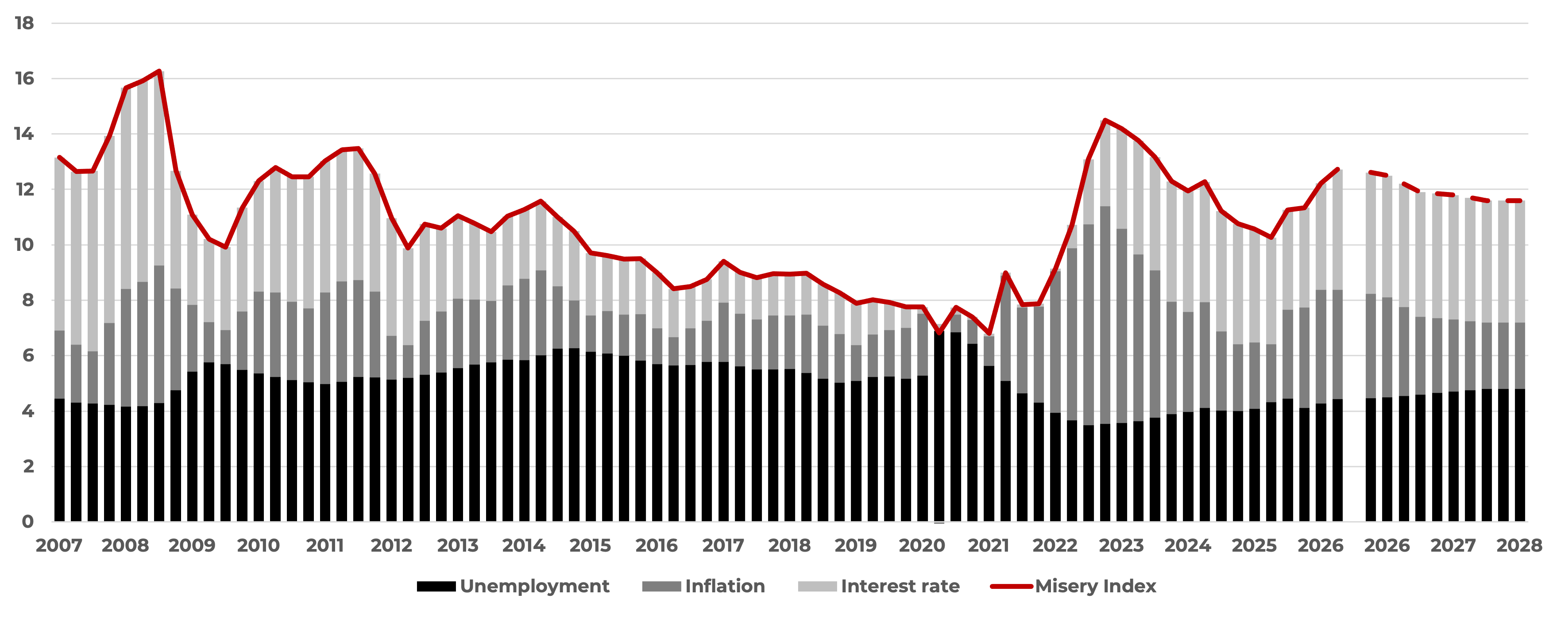
A look at the index from 2007 to June 2026 shows misery is back near post-pandemic highs, following recent deterioration in each of the index’s components. This has seen the index fully reverse the gains made since 2023.  

Figure 1: Australians' misery is on the rise

The misery index (red line) is the sum of inflation, unemployment and interest rates.

Source: Australian Bureau of Statistics, Reserve Bank of Australia, CEDA Analysis

A key culprit has been sticky inflation. After briefly returning to within the RBA’s target range of two to three per cent in 2025, headline consumer prices rose four per cent over the year to August. Current forecasts don’t see inflation returning to the middle of the target band until March 2028, with risks of further pressure stemming from the conflict in the Middle East.

This has led the Reserve Bank to hike interest rates four times already this year, taking the official cash rate back to a 15-year high. Some banks are predicting a fifth hike before the end of the year.1

Unemployment too has started to drift steadily higher as rate hikes have weighed on activity and more people have begun searching for work to help weather stubborn cost-of-living pressures.

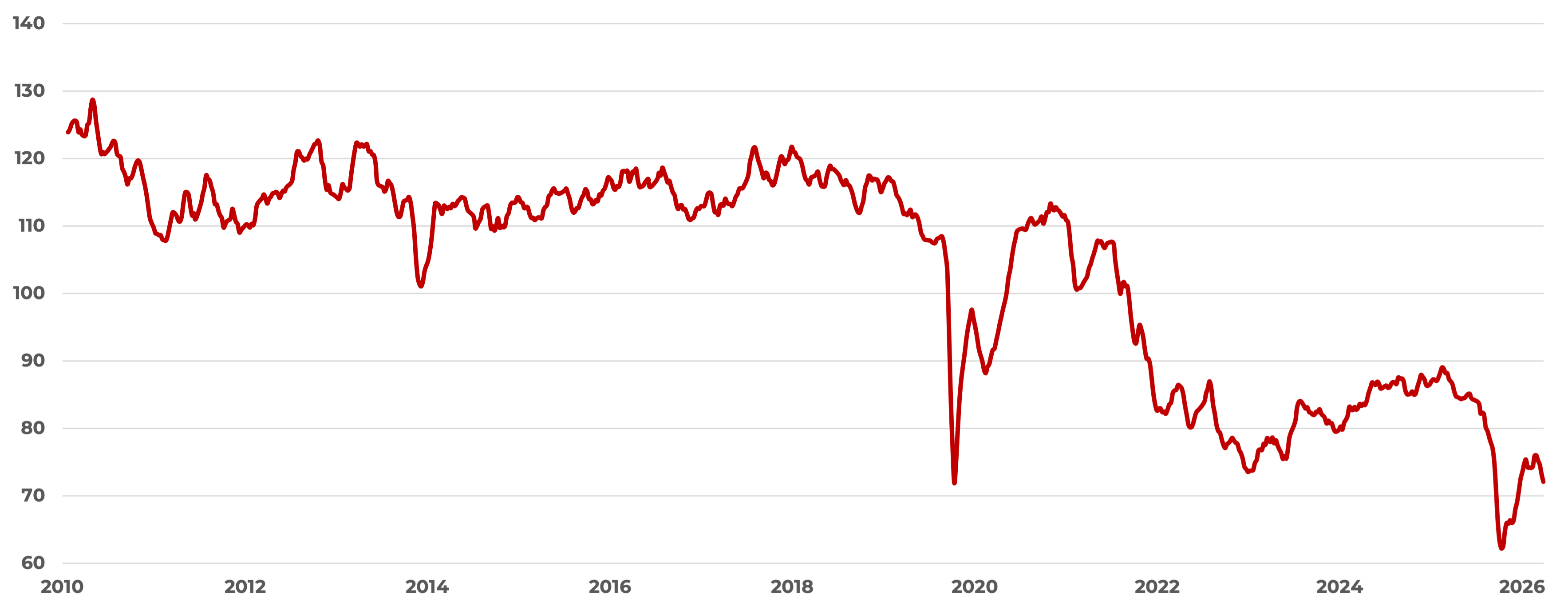
The challenges summarised by the misery index are reinforced by what Australians reveal when surveyed about their economic outlook. Consumer confidence remains deeply pessimistic, at levels rivalling those seen during the depths of the pandemic. A survey by the Lowy Institute finds that optimism about Australia’s economic performance over the next 5 years is at its lowest level since the survey began in 2005.2

Figure 1: Interest rates, inflation and conflict have seen sentiment plummet

ANZ-Roy Morgan Consumer Confidence

Source: ANZ

Australia’s resilient labour market has helped households weather rising inflation and interest rates

Through most of the 2010s, unemployment was the biggest contributor to Australia’s economic misery. Across that decade, unemployment averaged 5.5 per cent and peaked at 6.3 per cent in late 2014. Meanwhile, interest rates averaged 2.6 per cent and inflation 2.1 per cent.

Since the pandemic, however, the opposite has been true. Unemployment has remained relatively steady in recent years, averaging around 4 per cent between the start of 2022 and June 2026. That is considerably lower than outcomes in peer countries like New Zealand and Canada, which averaged 4.4 per cent and 6 per cent respectively over the same period.

And though the unemployment rate has been trending up, the economy is still adding jobs, with around 177,000 added since the start of the year. This has helped to insulate many households from the financial effects of rising inflation and interest rates. Though real household disposable income per capita has declined slightly this year, it is still higher on average than in 2023 and 2024.3 Household savings are also higher now than the decade average leading up to the pandemic.

The employment tailwind has supported the Government’s balance sheet as well as households’ through higher receipts of income tax. Of the 40 per cent increase in tax revenue since the pandemic to 2024-25, 87 per cent came from increases in income taxes.

Only productivity can deliver long-term reductions to misery

It is important to acknowledge the limitations of aggregate measures like the misery index. While the index provides a useful barometer of the high-level pressures shaping the economy, it does not capture the different ways that inflation, interest rates and unemployment are experienced by different groups of people.

Households that own their own homes or hold substantial savings will come out ahead when interest rates rise.

High inflation, by contrast, falls hardest on people with lower or fixed incomes, who spend a greater share of their income on essentials and have little or no buffer to absorb rising prices. For those who can’t find work and are unemployed, the pain is obvious.

There is also an economic trade-off between unemployment and inflation. In a tight labour market employers must compete harder for staff, pushing up wages. Higher wages must generally be paid for through increased prices, adding pressure to inflation.

This makes lowering the misery index a difficult task. Adjusting policy to alleviate one component often means pushing up another, and all three factors have trade-offs for different individuals.

Overcoming this dilemma can only be achieved through higher productivity.

Businesses that can produce the same amount of output with fewer inputs (or produce more output with the same level of inputs) are able to pay higher wages without having to raise prices.

If enough businesses can boost their productivity, inflation is more likely to remain at sustainable levels and interest rates need not go higher. That combination of higher real wages and lower interest rates can in turn also support growth, helping to keep more people in jobs.

This is why sustained momentum is critical to address Australia’s poor productivity performance. The Government’s 2025 economic reform roundtable highlighted the appetite and priorities for change, but these need to be paired with sustained action. 

With stronger productivity growth comes a stronger economy, and a country with far less to feel miserable about.


1. Canstar (2026), Interest rate forecast 2026: when will rates go up in Australia? https://www.canstar.com.au/home-loans/when-will-interest-rates-rise/, accessed 12 October 2026.

2. Lowy Institute (n.d.), Economic Optimism. https://poll.lowyinstitute.org/charts/economic-optimism/

3. Reserve Bank of Australia (2026), Financial Stability Review. 

Author

Daniel Beadle

Economist

Daniel Beadle

Economist