

AI is changing the world order. Now is our time to shape it.

Register for the AI Leadership Summit in Sydney | 27 October

Strong investment is necessary for future economic growth, innovation and productivity. In June 2026, investment spending by Australian businesses grew by 10.4%y/y in real terms, taking this expenditure up to 12.6% of GDP. This was its highest share of GDP since 2015, during the mining investment boom that peaked at 16.8% of GDP in 2012.

This increase is primarily – but not solely – being driven by an investment boom in the IT and telecommunication industry, which is investing heavily in data processing centres and new digital technologies. This new surge in spending comes on top of long-term upgrades to national energy and telecoms infrastructure (e.g. the NBN and renewables).
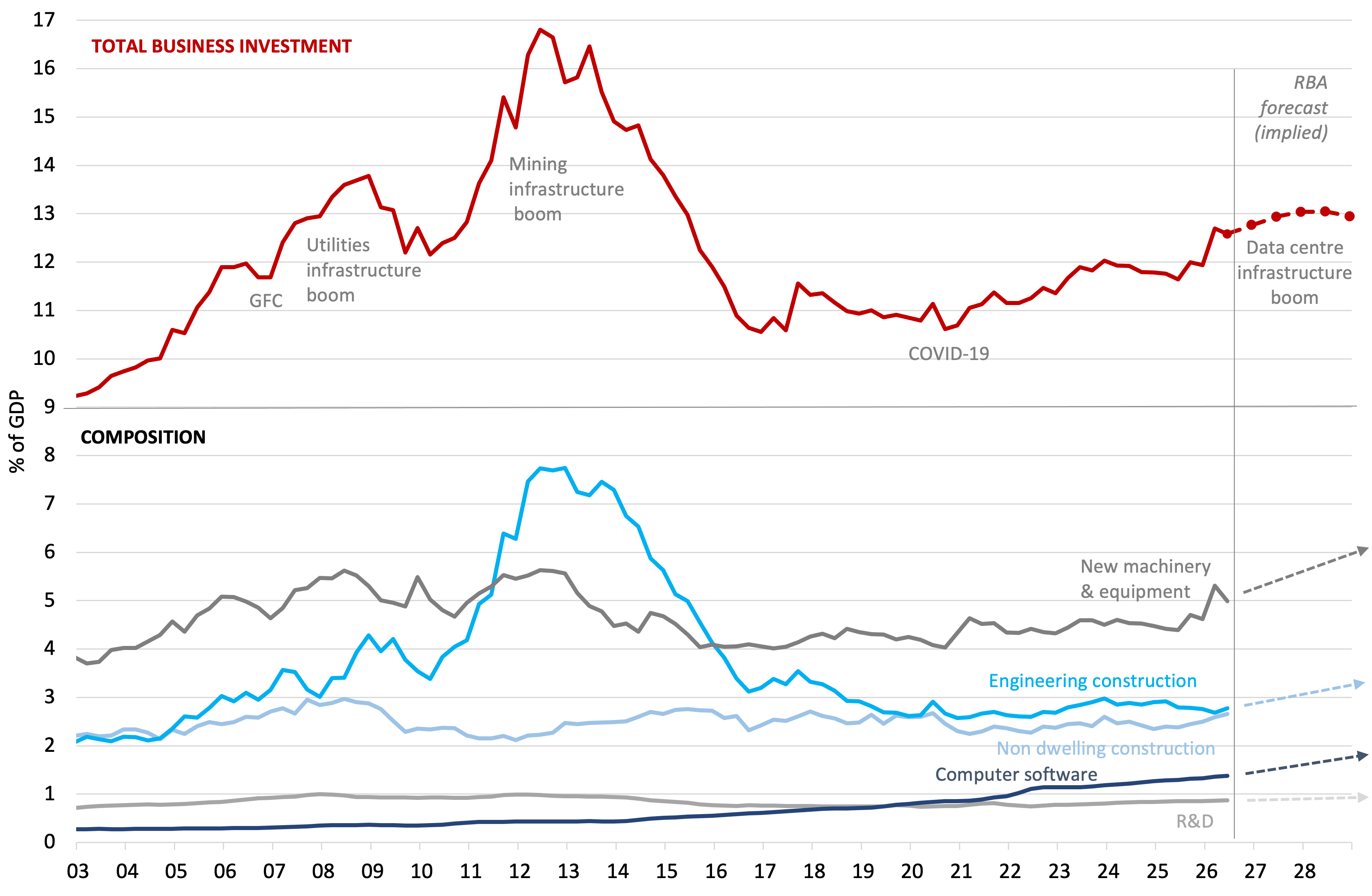
RBA forecasts and the surveyed capital expenditure (CAPEX) intentions of businesses imply that total business investment spending is likely to peak just above 13% of GDP sometime during 2027-28, before gently declining towards 12%. This expected bump is comparable in size to Australia’s last notable surge in non-mining investment, which resulted in a peak of 13.8% of GDP in 2008-09, driven by post-GFC business stimulus plus national infrastructure upgrades in energy and telecoms.

Previous infrastructure booms typically lasted between three to five years. Should this cycle follow similar trends, the current intensity of IT-related construction activity will be a defining story for the remainder of the decade, before leading into a longer period of follow-up investment as new technologies are adapted and adopted more widely.

Figure 1: 25 years of business investment, 2003 to 2028

Actual and expected total business investment, % of real GDP per quarter


Sources: ABS National Accounts, Jun 2026; RBA Statement on Monetary Policy, Aug 2026.
Note: forecast calculated by CEDA from RBA expectations for real GDP and business investment.

Who is investing in 2026?

In contrast to Australia’s last investment boom, our current expenditure surge is happening in non-mining industries, where CAPEX volumes grew by 13.6% over the year to June 2026, compared to only 1.4% in the mining sector. Even though mining CAPEX growth was muted, it still accounted for 25% of total CAPEX, due to its capital intensity and ongoing need to find and extract new resources.

Almost all of this year’s growth in non-mining CAPEX is concentrated in the ‘information and telecommunications’ industry, which almost doubled its real CAPEX spending from the previous year (+91% in 2025-26). Around two-thirds of this spending was on equipment and one third on built structures. This industry’s share of non-mining CAPEX more than doubled to 22% over the year to June 2026.

Outside the IT investment boom, other large non-mining industries that stepped up their investment activity during 2025-26 included administrative services (+17% annual CAPEX volume), transport services (+15%), healthcare (+14%) and retail trade (+12%). Investments in these industries are enabling digital technologies, services expansions, risk mitigation and energy transitions.

Surveyed CAPEX intentions indicate non-mining investment growth is set to accelerate in 2026-27. The latest estimate implies nominal spending growth of around 18%, or around 15% in inflation-adjusted terms (compared to 13.6% growth in 2025-26). History suggests this CAPEX estimate will be revised upwards as the year progresses.

What are businesses buying in 2026?

Much of the current investment surge is being driven by the rapid construction of new data centres to service digital technologies including ‘cloud’ computing, data storage and AI. It is important to note that this build out is import intensive. Estimates suggest that over 80% of the total investment in a typical new Australian data centre is spent on imported equipment, including servers and GPUs (68% of the total build cost and 100% imported), networking equipment (7%), electrical systems (5%) and IT cooling systems (4% of build cost and 100% imported).1

In 2025-26, the single largest category of imported business equipment was ‘automatic data processing machines’ and ADM parts, with a nominal import value of $23bn (up 60% y/y). 

As a comparison, this category alone is now larger than Australia’s total annual imports of freight trucks ($16bn) or telecoms equipment ($19bn in 2025-26).

In addition to this direct investment in buildings and equipment, Australian businesses collectively spent 9% more on computer software and 5% more on R&D investments in June 2026 than one year earlier (in volume terms). Business investment in software overtook spending on R&D during 2021 and looks set to grow further from here, as AI and other digital data technologies are adopted and adapted more widely. 

1. Yarra Capital Management (2026) Australia’s Data Centre Boom (a Counterview).  

Author

Julie Toth

Principal Economist

Julie Toth

Principal Economist