


AI is changing the world order. Now is our time to shape it.

Register for the AI Leadership Summit in Sydney | 27 October

School-age literacy and numeracy in Australia declined to a record low in 2025


Australia’s mean PISA score has fallen steadily and significantly over the past two decades in reading (-4.3% in mean scores since 2006) and especially in maths (-8.2%). In science, Australia hit a low point in 2018 and then made a partial recovery in 2022 and 2025, with consistently higher scores than for reading or maths.

Globally, mean PISA scores have fallen everywhere over the past two decades, with only a handful of recent exceptions. This has seen Australia’s PISA ‘ranking’ improve, even though our scores deteriorated. In reading, Australia ranked 10th in 2025, up from 12th place in 2022. In maths, Australia ranked 16th in 2025, up slightly from 17th in 2022.1 
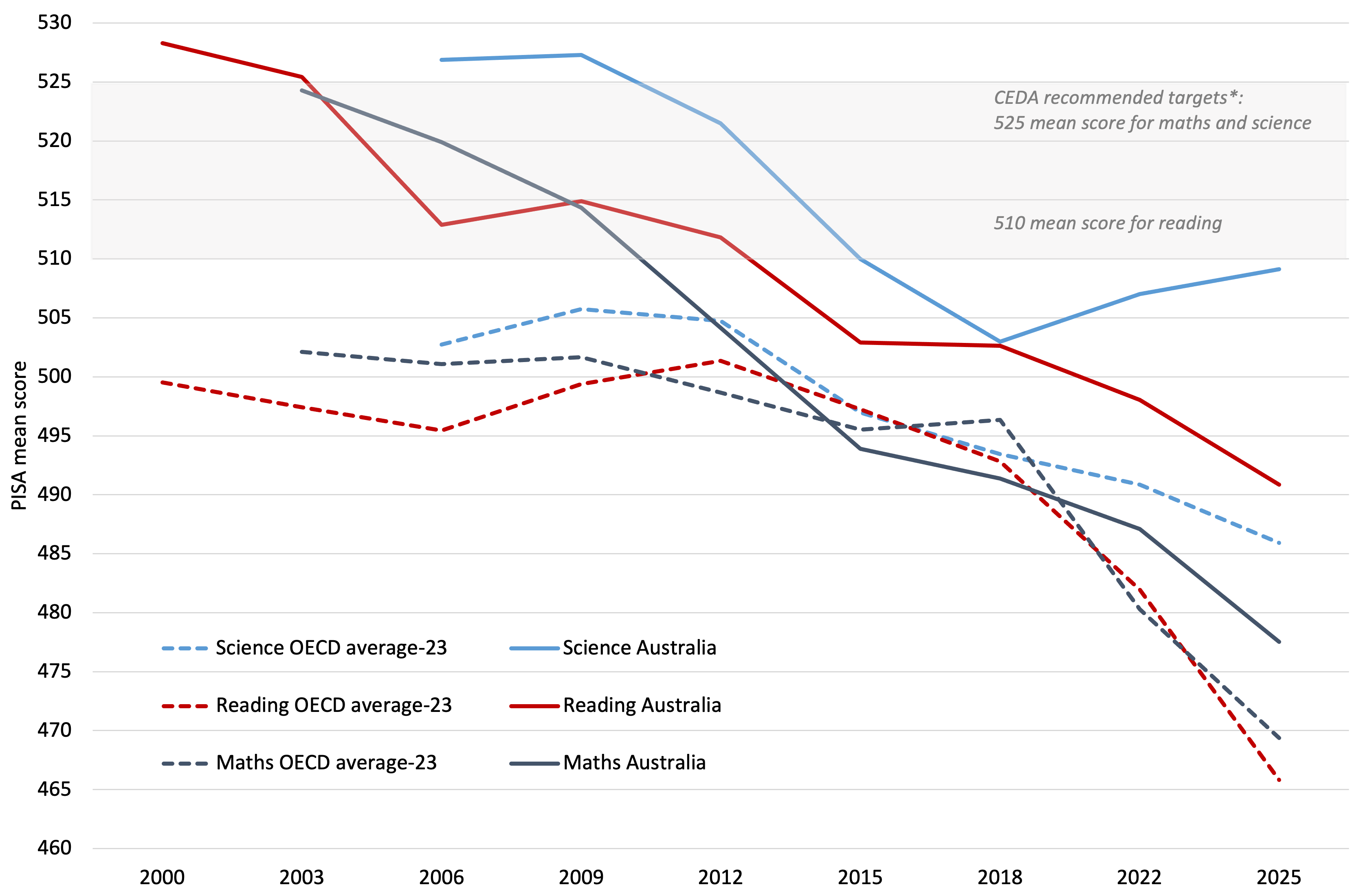

CEDA recommends that Australia aims for a PISA performance that is comparable to the top 5 nations globally. This means achieving a mean score of 525 points in maths and science, and 510 points in reading. Australia has achieved these benchmarks previously in reading (2000 to 2012) and science (2006 and 2009) but never in maths. Across all three domains, the highest national mean scores were achieved by China (Beijing, Shanghai, Jiangsu and Zhejiang), Singapore, Macao, Taiwan and Japan in 2025.

Figure 1: 25 years of decline in PISA mean scores, 2000 to 2025

Source: OECD 2026, PISA 2025 Results: Australia, https://www.oecd.org/en/publications/pisa-2025-results-volume-i-country-notes_2d4ff9ea-en/australia_20d725d6-en.html.

* CEDA recommends that Australia targets a minimum mean score of 525 points for maths and science and 510 points for reading, based on the mean scores of the top 5 countries.

A growing legacy of low performance


Reflecting this steep decline in mean scores, a growing proportion of students are falling into the lowest PISA performance range (PISA level 2 or lower, or 409 points, on a 6-level scale), with correspondingly fewer high-achievers (level 5 or higher). PISA proficiency Level 2 is the minimum required for functional literacy and numeracy.

The deterioration in our maths performance is especially stark. 29% of Australian students participating in PISA scored level 2 or lower in 2025, compared to 13% in 2006. Conversely, only 10% scored level 5 or higher in PISA in 2025, compared to 20% in 2006.


In reading, 23% of Australian students participating in PISA achieved level 2 or lower in 2025, compared to 13% with a low reading score in 2006.

This indicates that a very significant – and growing – share of Australian teens are falling behind, to a degree that affects their ability to engage, participate and prosper. If it is not addressed, low literacy and numeracy can form a permanent barrier to participation in subsequent formal education, workplace training and life-long learning.


Multiple influences suggest a multi-faceted response

This year’s PISA results highlight multiple factors affecting literacy and numeracy, locally and globally.

  • Socio-economic status is one of the most significant and persistent predictors of PISA performance within Australia and globally, but it does not account for all of it. In 2025, socio-economic status accounted for 9% of the variation in science performance scores in Australia and 12% on average across OECD countries. The socio-economic gap narrowed in Australia over the decade to 2025, but this was due to a larger decline in performance among advantaged students.
  • High spending per student does not guarantee high performance, at a national level. The OECD notes that: “national wealth accounts for just half of the variation in countries’ performance. … good policies and wise spending choices are far stronger predictors for performance”. For example, the wealthy enclave of Luxembourg spent the most per student in 2025 (US$288,521), but ranked 35th for reading and 34th for maths, well behind several European neighbouring countries that spend far less.
  • Access to adequate resources was relevant, with half of all Australian students attending schools that reported shortages of teaching staff in 2025 (compared to 39% across the OECD) and a quarter reporting shortages of physical infrastructure.
  • Student curiosity, effort and attitude appeared to affect PISA outcomes to a greater degree in Australia than across other OECD countries in 2025. Of note, Australian students who ‘greatly valued’ their time in school achieved scores that were 44 points higher (on average) than unmotivated students, compared to a 27-point lead across the OECD (after adjusting for socio-economic profiles). This suggests better student motivation can ‘nudge up’ performance across all schools.
Digital technologies in the classroom and beyond

Digital technology uptake and its impact on education outcomes was mixed in 2025. Globally, the mean science score was highest for students who ‘never use AI’ in their schoolwork, compared to those who do. However, students who used AI regularly for general (non-school) purposes also scored highly in science, and at similar levels to non-users. The OECD found that AI-specific skill development “opportunities are more common among socio-economically advantaged students, risking a growing AI divide”. 

Several PISA measures suggest that Australian schools are ahead of the pack on digital uptake and management:

  • Australian students reported an average of 2.6 hours per day on digital devices at school for learning activities (above the OECD average of 1.7 hours per day) plus 0.9 hours for leisure during school hours (below the OECD average of 1.1 hours);
  • 39% of Australian students reported being “often distracted” by digital devices, but the OECD found that “Australia is among the minority of countries in which digital distraction is not associated with significant differences in student performance”;
  • 50% of Australian students reported using AI chatbots to assist their learning at least once a week (compared to an OECD average of 46%). 15% of students in Australia (and on average across the OECD) reported never or ‘almost never’ using chatbots;
  • 85% of students in Australia attended schools that banned mobile phone use in 2025, up from 53% in 2022. Across all OECD countries, around half of students attended schools with a phone ban in 2025, up from 34% in 2022.
What is PISA?

The Programme for International Student Assessment (PISA) is a globally consistent evaluation of mathematics, reading, and science skills among 15 year olds. It is coordinated by the OECD and has been conducted regularly since 2000. The results are assessed against a six-level scale of proficiency and aggregated into national scores.

In 2025, over 760, 000 students took the PISA test across 91 countries, representing around 33 million 15-year-olds. This included 14,658 students in 766 schools in Australia, representing 275,400 15-year-old school students.

1. Ranked against countries that took part in the 2022 and 2025 PISA programs only. https://www.acer.org/au/news/article/pisa-2025-australian-students-outperform-oecd-average-in-worlds-largest-learning-assessment 

Author

Julie Toth

Principal Economist

Julie Toth

Principal Economist
