
AI is changing the world order. Now is our time to shape it.
Register for the AI Leadership Summit in Sydney | 27 October


CEDA'S 4TH ANNUAL CLIMATE AND ENERGY SUMMIT 2026
VIEW THE HIGHLIGHTS >>
We can lead in zero-carbon exports, but strong incentives and policies are critical to unlock growth. How has CEDA shaped the conversation?

Approved: How AI and data can transform Australia’s environmental approvals
As governments across Australia show increasing appetite to revisit and reform our environmental and planning regimes, there is a rare opportunity to seize this moment of change and leverage new technologies to accelerate progress even further.
The transition isn’t just about emissions, it’s also about how communities experience change. How has CEDA shaped the conversation?
Clean energy precincts: How to seize the green export opportunity
How can we turn renewables and critical minerals into export-ready clean energy hubs? Unique clusters of industry and innovation anchored by policy frameworks - or precincts - may be the answer.

In the dark: Australians need to know their disaster risk
Our research highlights a critical blind spot: While Australia accelerates its renewable transition, households and regions remain under-prepared for disaster risk.
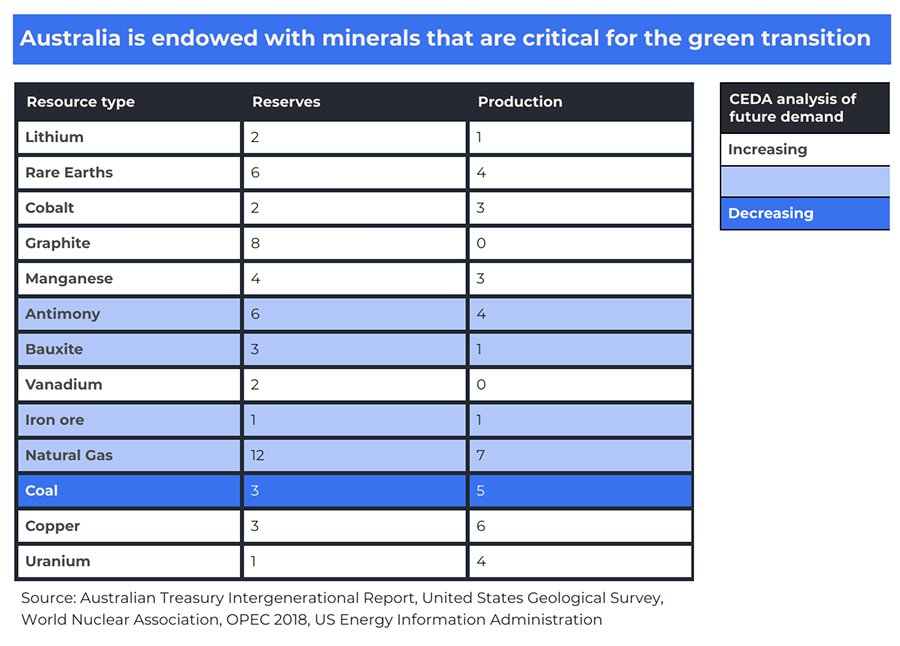
The energy transition is a critical part of CEDA's Progress 2050 vision. Here's how Australia is tracking.
- It is estimated that the 2000s mining boom boosted real per capita household disposable income by 13% from 2003 to 2013 (RBA).
- Australia has some of the world’s largest deposits of rare minerals required to produce electric vehicles and renewable energy technologies (IGR).
- Australia has some of the best solar and wind energy resources in the world (Geoscience Australia). For example, in just 16 years, South Australia has lifted its renewable energy share from 1% to 74% (Government of South Australia).

CEDA'S POLICY IMPACT
Previously, we called for reforms to the migration system to enable streamlined pathways for highly skilled clean energy workers. The Skills in Demand visa was a response to this, helping Australia acquire the skills it needs for the transition.

Join the conversation on Australia's climate and energy future
Be in the room with Australia’s clean energy investors and policymakers as they shape the next decade of transition.
What's next for Australia?
- High-income, resource-constrained countries in Northeast Asia and Europe are poised to import zero-carbon goods.
- But without government incentives and a “green premium,” markets alone can’t drive innovation fast enough.
- Currently, first-movers face higher costs but create knowledge and opportunities for subsequent entrants to the market.
- Now, we need to harness innovation gains across the wider economy while managing the social costs of carbon emissions.
- Across the board, energy projects should account for natural capital - like soil and ecosystems - not just financial capital.
- While it's possible for renewable diesel and sustainable aviation fuels to use up to 15% of Australia’s agricultural land, this requires smarter land planning.
- This could look like restoring underused land to create biodiversity assets, beyond just energy zones, and reusing brownfield sites to reduce emissions and boost transport efficiency.
- Upcoming EPBC Act reforms aim to streamline environmental approvals while ensuring nature-positive outcomes.
- Currently, government programs like Rewiring the Nation and private capital are aligned, but grid-scale projects face development delays. And each year of project slippage reduces returns and investor confidence.
- In this context, pension and super funds prefer proven assets, not early-stage construction risk.
- This means that regulatory certainty and policy continuity matter more now than technological progress.
- Energy hubs can revitalise regional economies, but only with parallel investment in housing and education to attract workers.