
AI is changing the world order. Now is our time to shape it.
Register for the AI Leadership Summit in Sydney | 27 October
01/12/2025
Sport delivers wide-ranging physical, psychological and social benefits for all people, but most especially those living with disability. However, participation rates for people with disability remain significantly lower than that of the general population and, accordingly, Australia’s successful bid for the 2032 Paralympic (and Olympic) Games included a commitment to increasing participation by 500,000. To honour this commitment and improve the lives of people with disabilities, there is a pressing need for a systematic framework offering practical, cost-effective and evidence-based approaches to identification, recruitment and sustained engagement of people with disabilities into sport.
Disability sport and the 2032 games
In September 2025, The University of Queensland and CEDA convened a Co-Lab that brought together leaders, advocates, athletes and stakeholders in disability sport to examine how collaboration and coordination could strengthen the impact of disability sport up to and beyond the Brisbane 2032 Games. Two imperatives were identified: the need to develop an environment that would support excellent performance by Australia in the Games, and arguably most importantly, the development of a system for disability sport that would leave ready access to sport for all people with disabilities as a legacy.
The wisdom of the crowd
A number of key messages emerged from the Co-Lab.
First, the goal must be to get as many people with a disability into sport as possible and maintain their engagement for as long as possible.
Second, Para Sport is but a limited sub-set of disability sport and there are many types and levels of disability and many adapted sports that are not amongst those available for competition at the Paralympics. A genuinely inclusive system needs to not only sustain Para Sports but also provide opportunities for disability groups and sports not included within the Paralympics.
Third, sports selection and sports entry must be safe and effective, particularly for the approximately 30 per cent of people with severe disabilities and high support needs. This requires skilled a workforce to deliver evidence-based programs. This entry point should be offered as early in the disability journey as possible and lead to pathways that enable all people with a disability to progress through to high-performance sport should they have the desire and capability. Presently, entry into disability sport is too frequently dependent on chance encounters and the availability of suitably qualified coaches with access to appropriate equipment and infrastructure. Sport choice and pathways can be limited and obscure.
Fourth, while there are many organisations who contribute to the disability sport space in one way or another, there is the absence of a clear framework that helps identify areas of both systems-level service shortage and duplication. There needs to be a framework in place to ensure that the pooled resources available to support disability sport are optimally applied and coordinated.
Envisioning an ideal disability sport system
With these messages in mind, we have turned our attention to what an ideal disability sport system (and pathways) might look like.
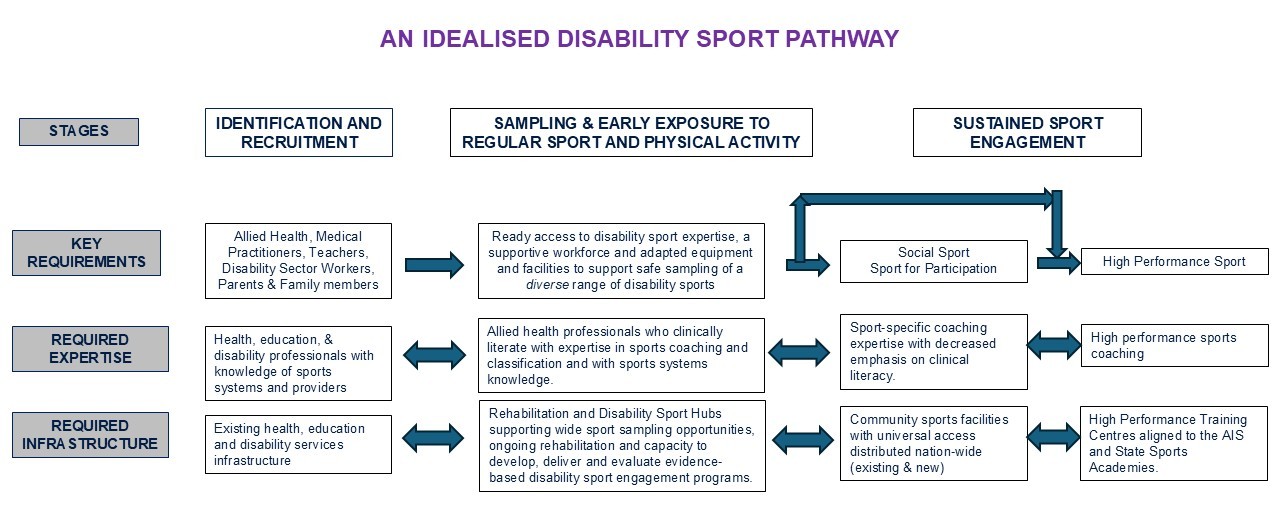
The proposed system framework is based on an orderly sequencing, from identification and recruitment, to sampling and early exposure, to different disability sport options and sustained engagement at either a social or high-performance level.
The framework deliberately incorporates several core features designed to enhance participation in disability sport:
- Cross-sector integration across education, health, sport and disability services- seeking initial engagement with people with disabilities where they are, regardless of whether they have congenital or acquired conditions and the severity of the disability.
- Business-as-usual approach minimising additional resource requirements by utilising existing resources optimally and making entry into disability sport more systematic and less reliant on elements of luck or privilege.
- A trained and skilled workforce, with emphasis on clinical literacy and sport classification expertise across coaching, allied health, medical practitioners and others.
- Stronger continuity across stages of participation and the aspiration of individuals, be they simply for social connection and fun or the pursuit of gold medal dreams.
These features address key challenges in disability sport, including limited awareness, inadequate facilities, un(der)trained personnel, inequitable access and fragmented transition pathways. Solutions are proposed through delivering, through purposeful design, sector integration, infrastructure support, workforce development, continuity across participation stages and a coordinated and sustainable pathway from initial engagement to long-term participation.
The establishment of one or more centralised ‘hubs’ (with the specialist capacity to support rehabilitation, diverse early sport sampling, research and workforce training) supported by regional ‘spokes’ plus the spread of universal access infrastructure is critical to providing the scalability, local adaptability and reach critical for success.
Next steps
Feedback and further refinement and discussion on the proposed framework is needed. Conducting comparative studies of pathway implementations, tracking long-term participant retention, assessing cost-effectiveness and refining approaches to meet the needs of different types and severities of disability will all be important. Ensuring policy alignment across the health, education and sport sectors will also be essential to achieving the dual goals of enhancing both participation and performance in disability sports.