
AI is changing the world order. Now is our time to shape it.
Register for the AI Leadership Summit in Sydney | 27 October
A year ago, we titled our Victorian budget outlook "Cost of living (still) in focus", marking back-to-back years of cost-of-living relief budgets. Twelve months on, little has changed. The 2026-27 Victorian Budget delivers another $2.5 billion in cost-of-living supports and housing initiatives.
These measures matter. Victorians are navigating the fourth major global shock in six years and relief is needed. But broad, universal support rather than targeted assistance means less going to those most in need and diminished fiscal headroom to respond to the next crisis. With an election looming these measures appear driven more by the political cycle than economic best practice, with the bill being paid on the state's credit card.
Victoria is the most indebted state in the country, with net debt projected to reach $199.3 billion by 2029-30. This year’s $700 million operating surplus, the first in seven years, is worth acknowledging, but it tells only part of the story. Once investments, including health, education and transport are factored in, this budget forecasts cash deficits averaging over $8 billion annually across the forward estimates, requiring yet more borrowing.
These investments are necessary to keep pace with Victoria’s rapidly growing population and expand the state’s capacity. But debt-funded infrastructure demands rigorous scrutiny of the costs and benefits. Not least because the interest on this debt has quickly grown to one of the government’s largest spending items. General government interest payments as a percentage of total expenses have doubled from around 3.5 per cent in the 2010s to 7 per cent in 2025-26 and are forecast to rise further to over 9.5 per cent by 2029-30.
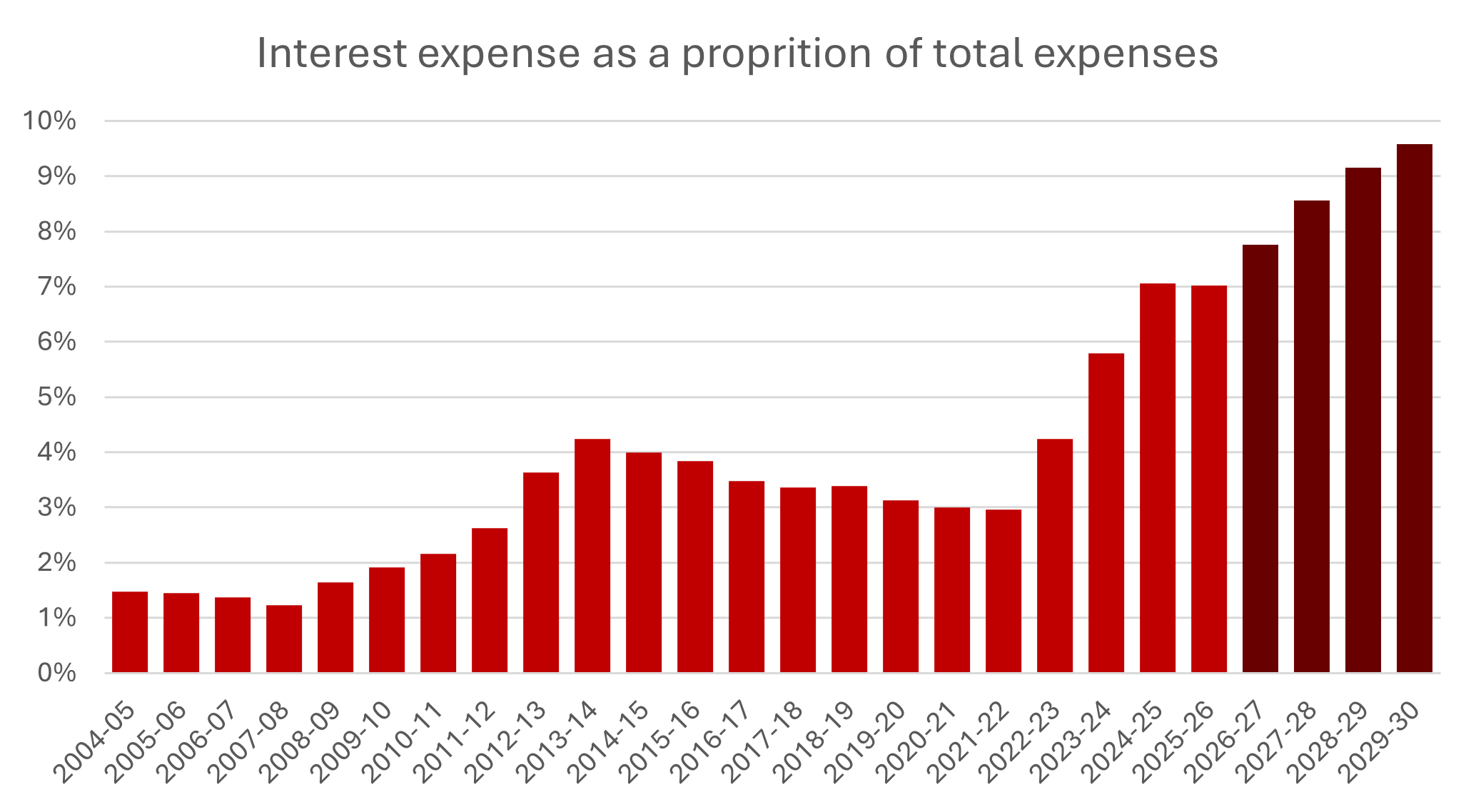
Note: shaded bars are forecasts.
Source: Table 4.2 Victorian Budget paper no. 2 2026-27 and historical data
When nearly one in ten dollars are forecast to go to servicing debt rather than delivering services, the case for greater fiscal discipline is clear. While the Government is making progress towards its goal of reducing net debt as a share of the economy – the last step in its fiscal strategy – further spending restraint is necessary to reduce the overall debt burden for future generations. More fundamentally, recent CEDA research highlights the need for greater focus on reigniting economic and business dynamism in Victoria, which would also contribute to improving the state’s fiscal position.
Cost of living
Responding to the Middle East fuel crisis and rising inflation with broad cost-of-living support has been a key focus of the 2026-27 budget.
A one-off 20 per cent vehicle registration rebate will cost the government $750 million and will return up to $186 per vehicle, with recipients able to claim the rebate for up to two vehicles. Alongside this, free public transport for May and half-price fares for the rest of the year will cost $432 million and are a politically popular policy.
There is no doubt that many households will be feeling significant financial strain from a combination of three successive interest rate rises, inflation, and now the Middle East fuel shock.
But limited fiscal headroom and resurgent inflationary pressures should have seen the Government exercise greater discipline in how it provides support during this difficult time. Doing so would have allowed cost-of-living measures to deliver greater impacts to the households facing the sharpest pressure.
The 20 per cent rebate for registration costs is particularly hard to reconcile. We anticipate that benefits will flow more heavily to households that live in areas well-serviced by public transport, or those able to afford multiple cars.
Meanwhile, there are some (but less fiscally significant) measures to support those who most need it, such as $11 million in grants for community organisations to deliver food relief. Additionally, $47.1 million is invested to help break the cycle of homelessness, including $26 million to expand support for rough sleepers and connect them to the help they need. These are welcome and if well implemented should deliver broader longer-term savings and benefits.
Housing
The Government has allocated $860 million to the Social Housing Growth Fund to deliver 7,000 more social homes in partnership with the community housing sector. But with 56,000 households still on the waitlist for social housing in 2025, there is still a lot of work to be done to ease the pressure in the state’s housing system.
The Government has also announced $97 million to continue delivering housing reforms, in addition to $37 million to unlock better uses of Victorian land, recognising that more needs to be done in order meet the target of 800,000 new homes in the decade to 2034.
These are positive developments and are consistent with CEDA’s calls for governments to boost housing supply by easing land-use restrictions.
But with just 54,000 dwelling completions in 2025, there is still much work to be done in order to meet targets that demand 80,000 dwellings be built annually.
Health
Health spending is the state’s largest expenditure item and the Government has continued to invest in this year’s budget. A further $3.9 billion has been assigned to meet Victoria’s healthcare needs. This includes $256.4 million to build and open new hospitals, $249 million for extended maternity services in Melbourne’s Western Suburbs, as well as $50.1 million to deliver 4,000 additional planned surgeries for children and cut waiting times.
A key priority is achieving faster emergency care, with $101.9 million allocated to upgrade Triple Zero Victoria’s telephone infrastructure. Additionally, $50.7 million has been set aside to support Ambulance Victoria. Over half of this is targeted to the organisation’s secondary triage team in order to help Victorians who don’t need an ambulance connect with the right care.
CEDA was also pleased to see the budget commit $80 million to continue support for residential aged care facilities, which are playing an increasingly critical role as our population ages.
Education
The Government is delivering $5.5 billion to schools and early childhood education to help children access high-quality learning opportunities. This includes $1.6 billion for new schools, school upgrades and maintenance.
Support for children with disabilities is a key focus, with $2.4 billion committed over five years to support children with disabilities in schools and provide disability inclusion for students with complex needs. This includes funding for Thriving Kids to support children aged 0-8 years with low to moderate support needs. Alongside other disability supports, this brings $4.7 billion in investments for people with disabilities in this year’s budget.
The budget also provides $459 million to help Victorians train for in-demand skills, over half of which is set aside to deliver government-subsidised training and free TAFE.
Business support
In contrast to significant cost-of-living supports for households, little has been announced for businesses in this year’s budget. Just $48 million has been set aside to support businesses, create jobs and invest in emerging industries, including $12 million to help Victorian businesses’ navigate government procurement processes and $3.3 million to design and pilot new training programs.
Over the forward estimates, $13.7 million has been provided for the government’s AI upskilling program, Digital Jobs, as well as for the implementation of its Sustainable Data Centre Action Plan. This aims to support improved planning for data centre development and ensure the industry is on a sustainable footing in Victoria.
Transport infrastructure pipeline
Following the delivery of the West Gate and Metro Tunnel projects in late 2025, Victoria’s transport investment has transitioned from expansion to moderation. The Government’s infrastructure investment continues to trend down, estimated at $19.4 billion in 2026-27, dropping from a peak of $24.2 billion in 2023-24.
New measures are focused on improving and maximising existing infrastructure, with $2.2 billion invested in upgrading Victoria’s public transport network and roads. This includes $1.6 billion in public transport investment, of which $673.6 million will be spent on 25 new locally made trains to boost the network’s capacity. A further $560 million is allocated in new funding for road maintenance to fix potholes and resurface roads.
Public safety
The Government also announced new measures to support public safety, including $397 million for expanding capacity in the corrections system.
While these measures can play an important role in helping Victorians feel safe, just as critical is providing broader social supports so that there are fewer pathways that see people land in front of the justice system.
In this area, it was good to see that $81 million had been allocated for early intervention initiatives and a further $100 million set aside for addressing family violence.
These are challenging, entrenched issues that require sustained policy attention and are deeply linked to the Government delivering on outcomes in health, education and employment. Meaningful progress will require ongoing investment and careful program design well beyond what any single budget cycle can address, but the long-term social and economic dividends of getting this right cannot be overstated.
To hear more on today’s State Budget, join CEDA for the Victorian State Budget Address this Friday with the Honourable Jaclyn Symes, Treasurer for Victoria; Minister for Industrial Relations; and Minister for Regional Development. Limited tickets still available here.