
AI is changing the world order. Now is our time to shape it.
Register for the AI Leadership Summit in Sydney | 27 October
This year’s Federal Budget makes meaningful progress on long-awaited reforms that place productivity and equity at their core.
The reforms outlined this year come at a time of substantial economic disruption. The economy is running at close to capacity, the global outlook is changing daily and resurgent inflation following the Middle East conflict has put the focus squarely back on the cost of living.
In this context, it is welcome to see the Government framing this Budget around housing, tax reform, intergenerational equity and regulatory burden. These are the right priorities.
Policy reforms are far from easy. They are politically divisive, challenging to implement and rarely deliver everything at once. While many (including CEDA) will debate the impacts and intricacies of tonight’s policy changes for some time to come, the fact that the Government is willing to use its political capital to advance long-term objectives in a short-term policy cycle is to be commended.
The budget bottom line and state of the economy
Four global crises in six years are a powerful reminder of why fiscal discipline and productivity reform matter for the Federal Government. Strong fiscal discipline in calmer times is the difference between having the flexibility to respond in a crisis and seeing people fall behind.
Tonight’s Budget estimates an underlying cash deficit of $31.5 billion in 2026-27, an improvement of $2.8 billion on the December MYEFO forecast. Elevated commodity prices today and greater tax revenue and spending cuts in the future will support continuing improvements in the Budget’s fiscal position across the forward estimates (Figure 1).
Net debt is estimated at $556 billion or 18.8 per cent of GDP in 2025-26 and forecast to peak at $767.8 billion or 21.9 per cent in 2029-30 (Figure 2). Limiting the scale of debt preserves the Government’s capacity to respond to future shocks without placing a larger burden on future generations.
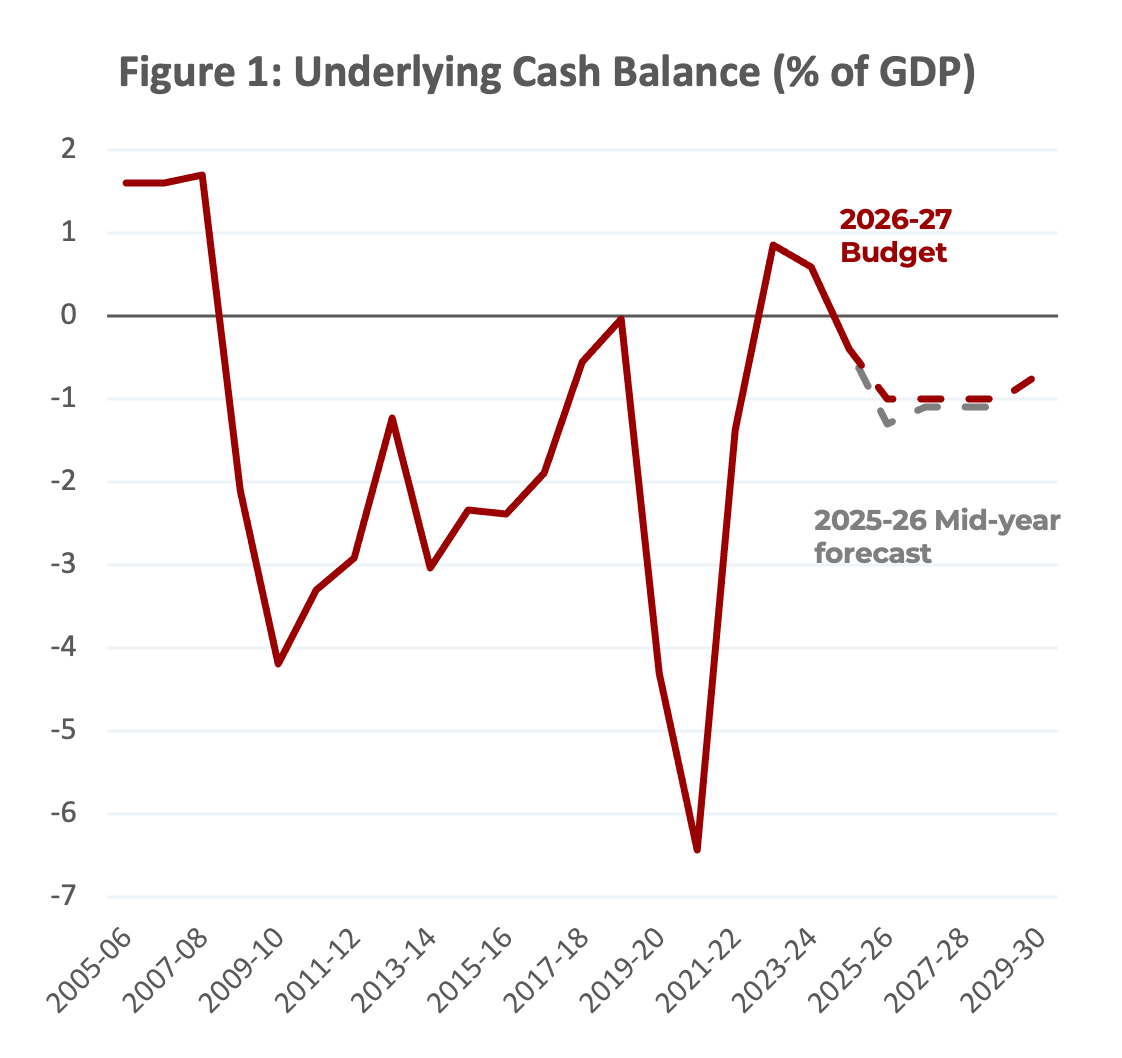 Source: Parliamentary Budget Office, MYEFO 2025-26 Table 3.1, Budget 2026-27 Table 3.1
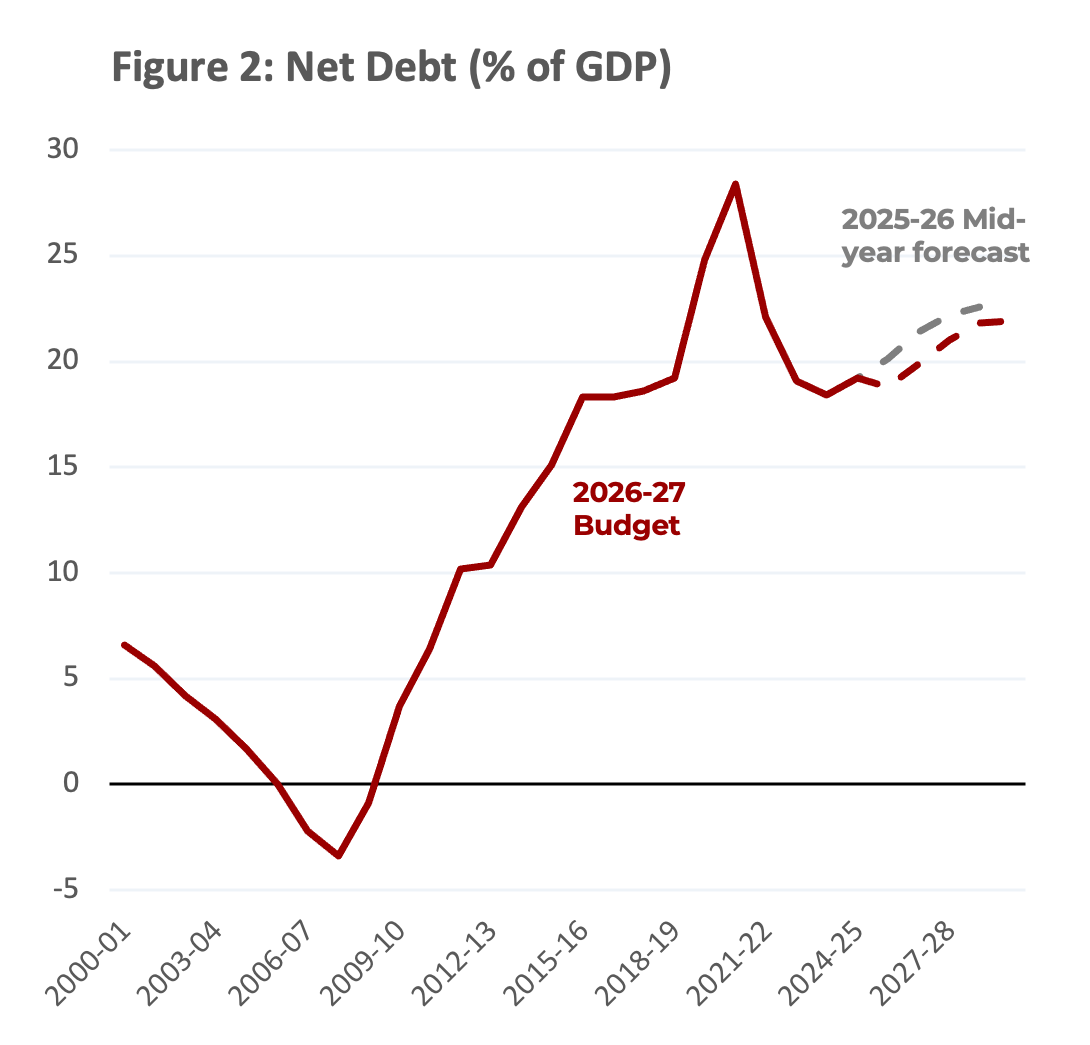 Source: Parliamentary Budget Office, MYEFO 2025-26 Table 3.1, Budget 2026-27 Table 3.1
The Budget is being delivered against a backdrop of weaker outlook for growth and resurgent inflation. The Reserve Bank has lifted interest rates three times in 2026, which now sit at their highest level since 2023.
The Treasurer has flagged that the economy is facing higher inflation expectations of 5 per cent to the June quarter 2026, largely driven by increases to automotive fuel prices and their flow on impacts.
Growth is expected to slow from 2.25 per cent in 2025-26 to 1.75 per cent in 2026-27. While activity is forecast to pick back up in 2027-28, this outcome assumes that global oil prices begin to decline from mid-2026 and stabilise in mid-2027.
Tax and spending
Tonight’s Budget delivers the most substantial changes to Australia’s tax settings since the introduction of the GST in 2000. CEDA commends the Government on its willingness to pursue contentious changes to rebalance the fairness of Australia’s tax system.
From July 2027, the 50 per cent Capital Gains Tax (CGT) discount will be replaced with inflation indexation and a 30 per cent minimum tax. Gains accrued before this date remain under the existing discount to ease the transition, while investors in new residential properties can choose between the two systems. Income support and pension recipients will be exempt from the minimum tax.
Negative gearing arrangements are also being tightened. From July next year, negative gearing on established residential properties will be restricted, with losses only deductible against rental income or residential property capital gains, and excess losses carried forward. Properties acquired before Budget night are exempt, as are new builds, build-to-rent developments, widely held trusts, superannuation funds, and private investors supporting government housing programs.
These changes make an important contribution to rebalancing Australia’s tax settings by shifting incentives that favour existing housing stock to promoting new supply and productivity-enhancing investment elsewhere.
The new settings will also address the tendency for benefits to accrue primarily to wealthier households. Under previous settings, the top 10 per cent of salary earners were estimated to receive 76 per cent of the CGT discount in 2025-26, while the top 30 per cent had been expected to claim 67 per cent of negative gearing rental deductions.1
Reform on tax settings for trusts also aimed to rebalance tax concessions. Tonight’s Budget introduced a 30 per cent minimum tax rate on discretionary trusts from July 2028, winding back a tax planning vehicle used disproportionately by wealthy households. Primary production income is exempt, protecting farmers, as are charitable trusts, superannuation funds, deceased estates and special disability trusts. Small businesses wishing to restructure out of discretionary trusts will have three years of rollover relief from July 2027 to do so.
Together, these three reforms are estimated to raise $8.1 billion in additional revenue over the forward estimates, contributing to higher government receipts compared to December’s forecasts (Figure 3). They are a welcome first step towards the broad tax reform that CEDA has long called for. Future budgets should build on this by addressing the over-reliance on personal income tax and strengthening the long-term sustainability of the tax base.
Complementing these revenue gains, this budget includes $63.8 billion in savings. Government payments as a per cent of GDP are forecast to peak in 2027-28 before falling back to 26.2 per cent of GDP in 2029-30 (Figure 4).
The largest saving has been achieved through the scaling back of the NDIS, which is now targeted to grow at an annual rate of two per cent over the next four years, considerably lower than the previously forecast ten per cent.
These cuts are partly offset by increases in defence spending, which is set to receive an additional $14 billion in funding over the next four years. Other major measures include a $14.8 billion fuel security package and $25 billion for public hospitals.
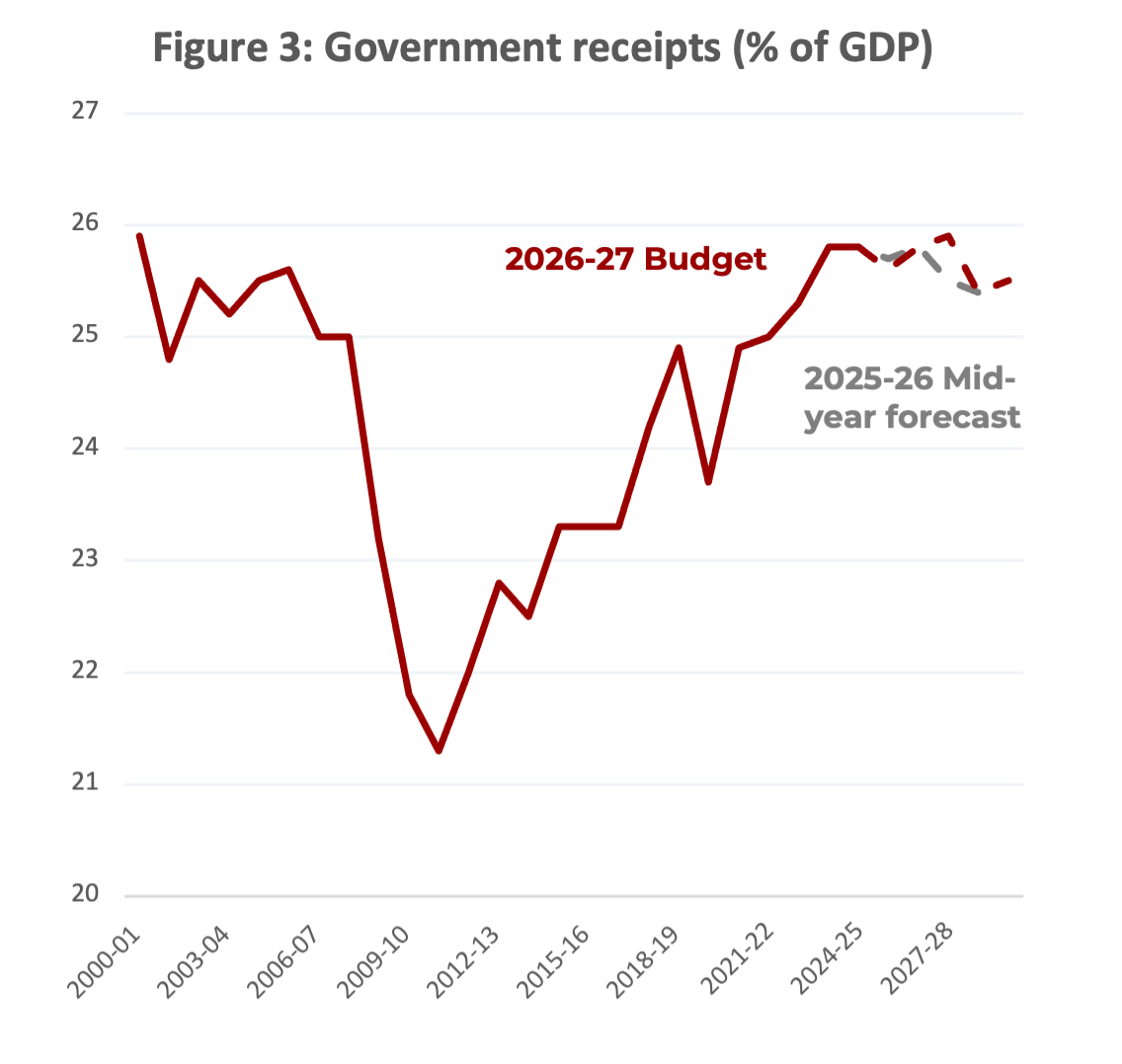 Source: Parliamentary Budget Office, MYEFO 2025-26 Table 3.1, Budget 2026-27 Table 3.1
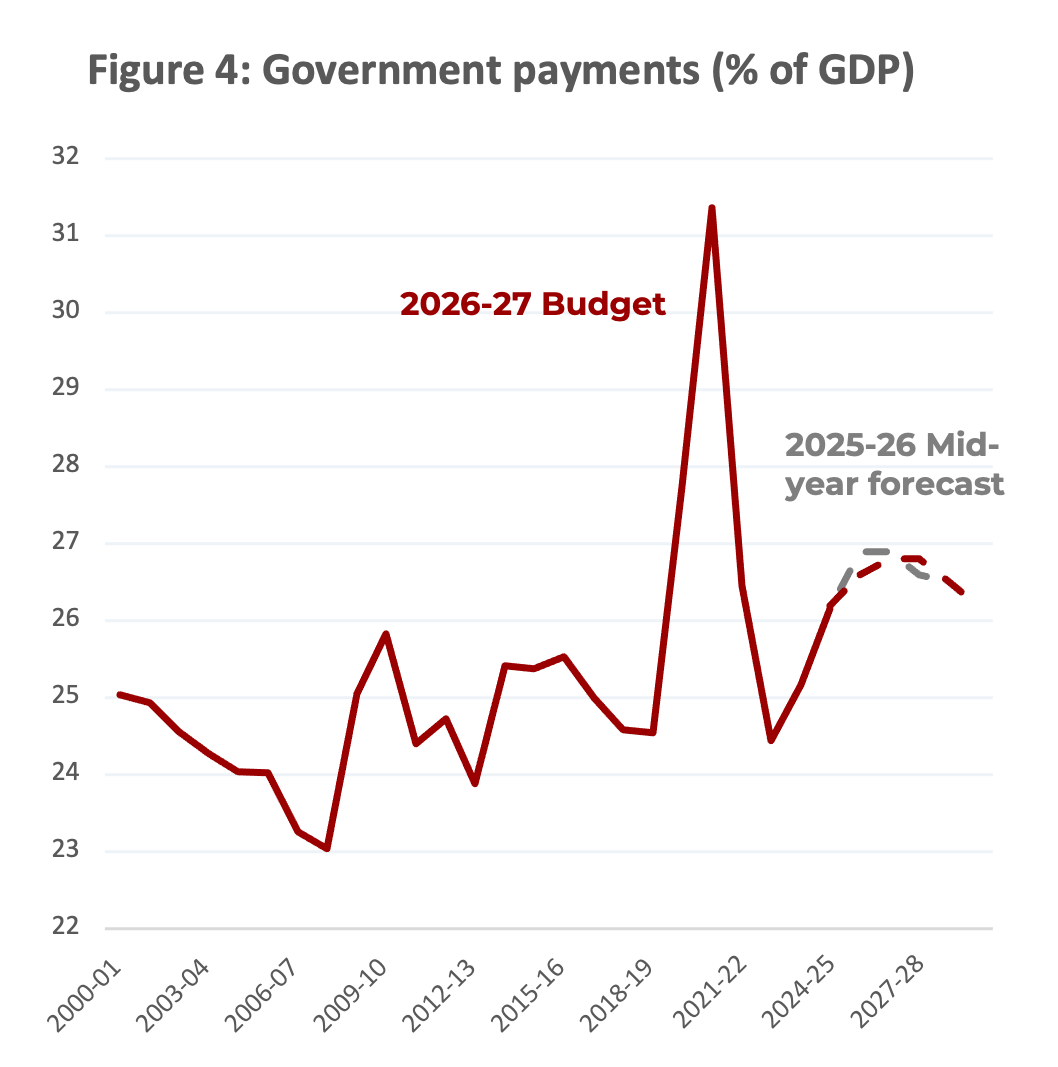 Source: Parliamentary Budget Office, MYEFO 2025-26 Table 3.1, Budget 2026-27 Table 3.1
Housing
Housing remains a defining challenge for Australia, and the Budget contains several measures squarely aimed at improving affordability for young Australians.
We expect that changes to negative gearing and capital gains tax arrangements will help address intergenerational inequity challenges in the housing market by shifting the mix of buyers away from investors and towards owner-occupiers. The Government expects that these changes will see housing price growth moderate over the coming years by around two per cent, compared with no policy changes being made. Over the coming decade, the changes are anticipated to support 75,000 new homeowners entering the market.
Tax reforms are welcome but must be considered alongside the more fundamental constraint. Australia is not building enough homes. Without a sustained lift in new housing construction, demand-side reforms can only do so much. On this front, several measures announced in tonight's budget are very welcome.
A $2 billion investment to support states and local councils to deliver the infrastructure needed to unlock new housing is a meaningful step. Water, transport, and energy connections are persistent bottlenecks, and tying funding to states committing to reforms that drive productivity in the housing sector and increase housing supply is a sensible use of Commonwealth support. The investment is expected to unlock 65,000 additional homes over the next decade.
New agreements with states and territories will support the uptake of modern methods of construction. Removing barriers to adoption of new construction methods is one of the most direct ways to boost supply in a sector where productivity growth has been negative in recent years.
A further $60 million will help young Australians access social housing. Because rents are scaled to income, the top-up rebalances the incentive in favour of young people, who receive lower income support than other recipients. It is a useful intervention, but lifting social housing supply remains the most effective way to help the 190,000 households still on the waitlist.
Resolving Australia's housing challenge requires a sustained focus on supply. These measures move in the right direction, and the government should keep building on them.
Productivity and investment
This year’s Budget framed productivity growth as a key priority and necessary step to build economic resilience. With stagnant productivity weighing on the outlook for growth and creating risks for inflation, this is the right priority.
But while the Budget brought some progress, more will need to be done in coming years to meaningfully address this challenge.
Changes were mainly framed around cutting red tape for businesses, with the reduction in regulatory burden estimated to be worth $10.2 billion annually.
A large part of this came from over $500 million to implement changes to the Environmental Protection and Biodiversity Conservation Act, including $106 million for AI-enabled assessments - a key recommendation from recent CEDA research.
Small and young businesses were beneficiaries of the Government’s productivity push. The Government made permanent its $20,000 instant asset write off, introduced loss refundability for start-ups in their first two years and a higher offset for ‘core’ R&D spending. Venture capital concessions were also expanded.
With small businesses comprising over 90 per cent of all Australian firms, these changes should hopefully spur greater risk taking and investment that can kick-start productivity growth.
Investment has been too low for too long, with productivity suffering as a result. CEDA research has shown that the rate of business start-ups has fallen to record lows.
We also welcomed the Budget’s focus on developing a single national market. Moves to harmonise standards across states and progress national licensing have been longstanding policy priorities for CEDA, and we were pleased to see these receive focus in this year’s budget.
Cost of living
Cost of living pressures remain front of mind for households, and tonight's budget includes further relief measures.
The centrepiece is the Working Australians Tax Offset (WATO). Beginning in 2027-28, the WATO will provide an annual tax offset of up to $250 for labour income, effectively increasing the tax-free threshold by $1,800, at a cost of $6.4 billion over the forward estimates. The WATO will be available to over 13 million workers.
The fuel excise was halved in March for three months, with the heavy vehicle road user charge waived until June. The combined package has been estimated at $2.9 billion over the three-month period.
Newly announced cost of living support comes on top of state-based measures included in the recent West Australian and Victorian budgets. While the WATO will not flow through to households until 2027-28, the package leans heavily on universal rather than targeted relief. In a constrained fiscal environment, we would have preferred to see support be more targeted to those who need it most, rather than spread across the board.
Further tax support comes from the $1,000 instant tax deduction for work-related expenses, which will simplify tax time for millions of Australians and deliver a modest boost to disposable incomes, particularly for lower and middle-income earners who are less likely to itemise deductions.
The Government is committing $5.9 billion to new and amended listings on the Pharmaceutical Benefits Scheme (PBS), providing more, cheaper medicines. The maximum general co-payment under the PBS will be reduced to $25, with the concessional rate frozen at $7.70. Alongside this, the Medicare levy low-income thresholds have been increased by 2.9 per cent for singles, families, seniors and pensioners.
We welcome employment services funding to support Australians into employment, including $285.6 million over the forward estimates to improve the employment services system and support future reform.
The Federal Government’s Paid Parental Leave has also been extended to six months paid leave for eligible families.
Fuel security
The Budget contains a substantial package to strengthen Australia’s fuel security. The Government has created a $14.8 billion Strengthening Australia’s Fuel Resilience package. This includes a $7.5 billion Fuel and Fertiliser Security Facility, a $3.2 billion Australian Fuel Security Reserve. The Government has also highlighted the implementation of a 20 per cent gas reservation, making more clean fuels domestically and continued electrification.
The Government is aiming to increase the Minimum Stockholding Obligation for every type of fuel by around 10 days, and an additional 10 days for jet fuel and diesel. Jet fuel and diesel will increase to 50 days of supply and storage. The Fuel Security Services Payment will be amended so refineries have more access to existing funds.
In a more uncertain world, it is reasonable to invest in genuine economic security. A 50-day strategic reserve of diesel and jet fuel is a reasonable compromise that reflects Australia’s import dependency without committing the very large resources that would be required for a full 90-day reserve.
Over the longer term, the greatest insurance policy against future fuel shocks is to reduce the fossil-fuel intensity of the Australian economy. With around half a million electric vehicles on the road today, many households are already seeing what that looks like in practice. Maintaining momentum on electrification will allow more households and businesses to benefit from greater independence from imported fuel.
Here, the Budget recalibrates electric vehicle support to a permanent 25 per cent fringe benefits tax (FBT) discount. The new discount applies to eligible electric cars costing over $75,000 from 1 April 2027, and to all eligible electric cars from 1 April 2029. Electric vehicles costing up to $75,000 will continue to receive a full FBT exemption, if commenced before 1 April 2029.
CEDA welcomes the Government’s move to recalibrate its electric vehicle policies to be more narrowly scoped while continuing to incentivise households to make the switch.
Migration
This Budget will prioritise migration for onshore migrants, allocating 70 per cent of migrant places to skilled migrants; offshore migration places will be predominantly allocated to high-skilled migrants. The Government is reforming the migration points test, to select better educated, higher-skilled and younger migrants that can help drive productivity. The Working Holiday Maker visas are also being reformed.
There is an announced $85.2 million for migrant skills recognition and up to 4,000 additional skilled migrant trade workers.
Migration is one of Australia’s most powerful tools for addressing skills shortages in priority sectors such as construction, aged care and health. Better long-term planning of the migration system remains crucial.
Better integration of migration policy with workforce planning would support both productivity and the social compact, ensuring Australia can fill critical skill gaps without overloading housing or infrastructure.
Aged care
The Budget includes $3.7 billion to support older Australians, building on the implementation of the new Aged Care Act that came into effect on 1 July 2025.
The headline measures are anchored by a $1 billion reinstatement of personal care services, including showering, continence care and dressing, within the Support at Home clinical service list from 1 October. An additional 5,000 residential aged care beds will be funded annually from July 2027, with $605 million over four years in capital subsidies for providers who build or expand residential accommodation. The package also delivers up to 20 additional Specialist Dementia Care Program units and expands the Hospital to Aged Care Dementia Support Program.
As with the NDIS, the key test of these measures will be in implementation, workforce capacity and the interaction between the Commonwealth aged care system and state-funded health services, which already carry significant pressure from an ageing population.
NDIS
The Budget contains the most significant savings measures through the National Disability Insurance Scheme (NDIS).
The Government is targeting NDIS growth to fall from around 10 per cent per year to 2 per cent per year on average over four years, with a participant cap of around 600,000 by 2030, removing roughly 160,000 people from projected participation. The expected savings are $37.8 billion over the forward estimates, with longer-term reductions of up to $184.9 billion over the next decade. There is a forecast cost shift to the states of $32.5 billion. These changes are necessary to keep the Scheme sustainable. They are also a bolder step than previous budgets have attempted.
Achieving average growth of 2 per cent over four years is a significant adjustment, particularly given that current annual growth has been running well above that level. There is a real risk of loss of supports cost-shifting to state-funded health, aged care and education systems if the partial replacement program, Thriving Kids, is not yet fully operating when participants begin to transition off the Scheme. There is also a significant funding gap in the billions of dollars between current services, estimated cost to states and future Thriving Kids funding. Close monitoring of implementation and the flow-on costs to states will be essential.
1 Parliamentary Budget Office [PBO]. “Cost of Negative Gearing and Capital Gains Tax Discount,” April 17, 2025. https://www.pbo.gov.au/publications-and-data/publications/costings/cost-of-negative-gearing-and-capital-gains-tax-discount.