
Australia has a strong hand. Are we playing it well?
Since the First Peoples arrived on our shores over 60,000 years ago, Australia has been a country of migrants. Today, over one in three people currently living in Australia were born overseas.
This flow of people to Australia has historically offered large social and economic benefits. Migration plays an important role in bringing in new skills, enhancing growth and enriching Australia’s cultural diversity.
But when the flow of migration is seen as uncontrolled and unsustainable, community support can waver. Concerns around housing affordability and competition for work overshadow the benefits that migrants can bring.
This short briefing, the first in a new series from CEDA, aims to separate fact from fiction and explores the current state of migration in Australia.
Migration trends by the numbers
Net Overseas Migration (NOM) is the figure most often cited in debate about migration. The measure captures the flow of people entering and exiting Australia.
As Australia closed its borders during the pandemic, inbound migration plummeted and NOM became negative (figure 1). When borders were opened and travel resumed, migration rebounded and reached a peak of 555,800 in September 2023.
Headline figures have since fallen sharply, with seven consecutive quarters of declining net migration. As of September 2025, NOM had declined by over 240,000.1 The most recent federal budget forecasts that NOM will return to around 225,000 by 2028.2
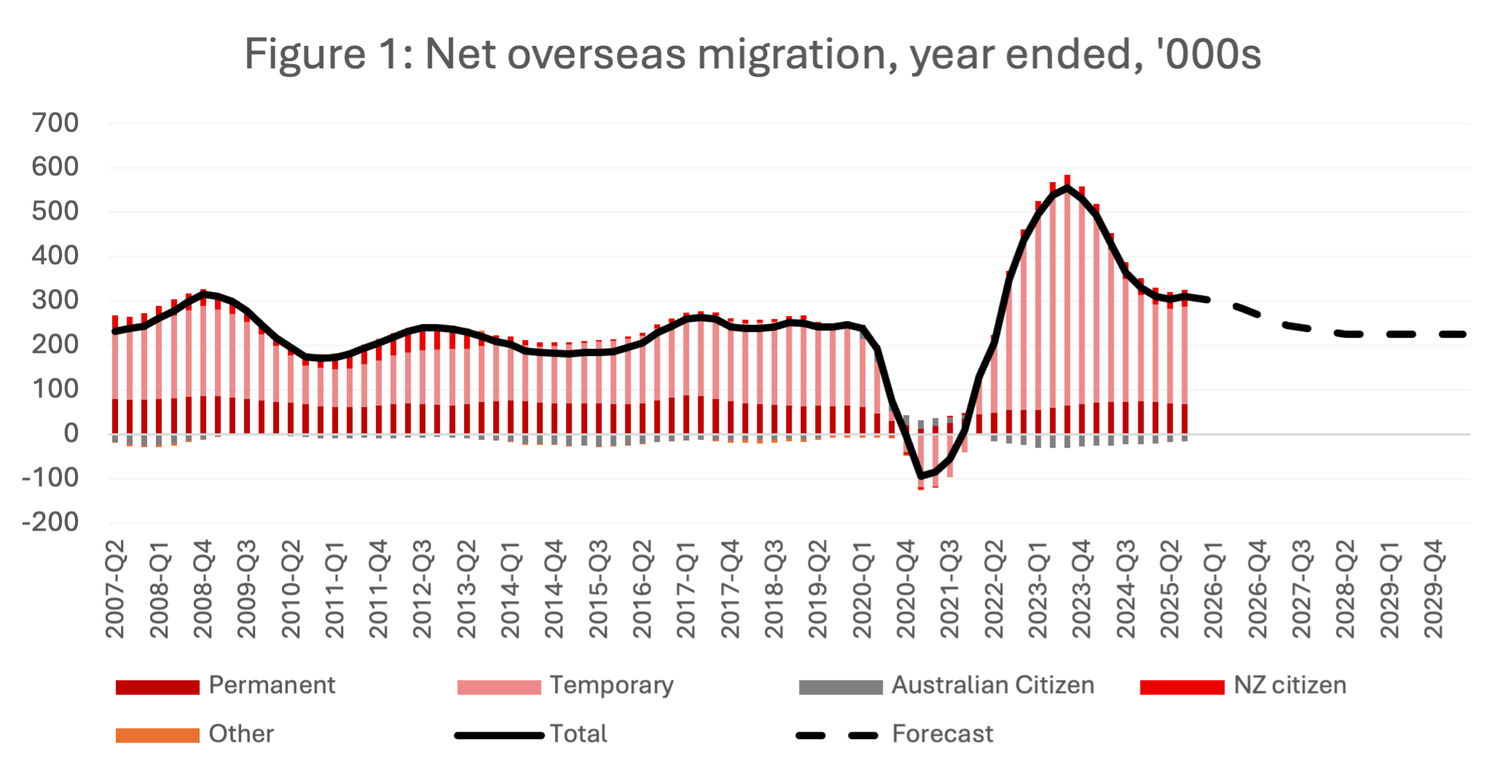 Source: Australian Bureau of Statistics; Commonwealth Treasury 2026-27, Budget Paper 1, Table 2.2
It is important to note that the post-pandemic increase in NOM reflected not only the release of pent-up demand for travel but also bipartisan support for broader migration to help address acute workforce shortages in 2022.3
This saw the duration of graduate visas extended from two to four years and the expansion of the working holiday program for UK citizens. The result has been that while arrivals into Australia have fallen by 170,000 since their peak, departures have not yet returned to the pre-pandemic levels (figure 2).
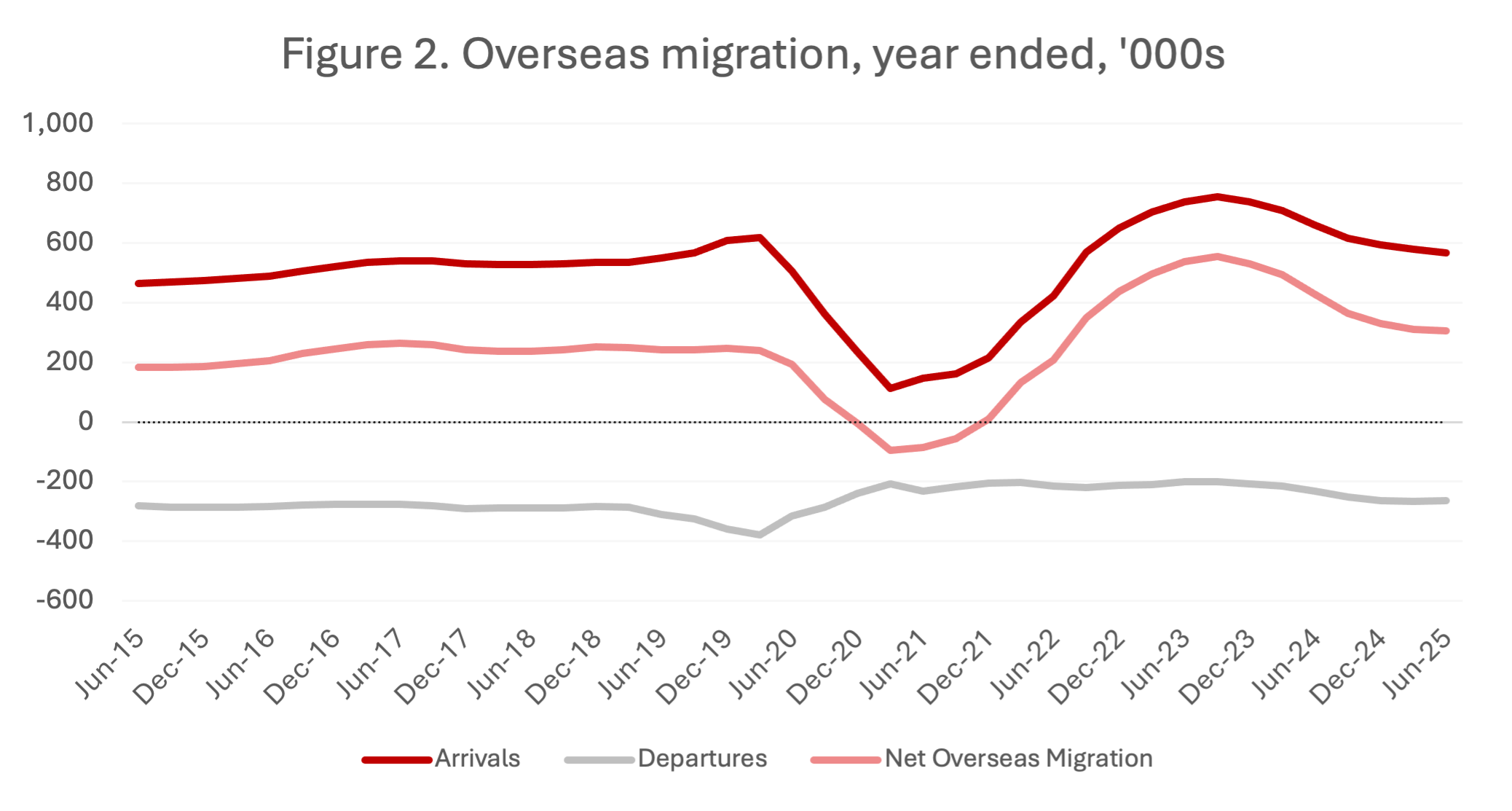 Source: Australian Bureau of Statistics
Visas are important to analyse because they are the lever through which the federal government can most directly influence migration trends. This is in contrast to NOM, which includes the movements of Australian citizens that are both less relevant to migration debates and harder for the government to influence.
Importantly, changes in visa numbers incorporate the evolving status of people already residing in Australia. In 2024–25, almost half of the 185,000 permanent visas granted went to people already living here on temporary visas.4
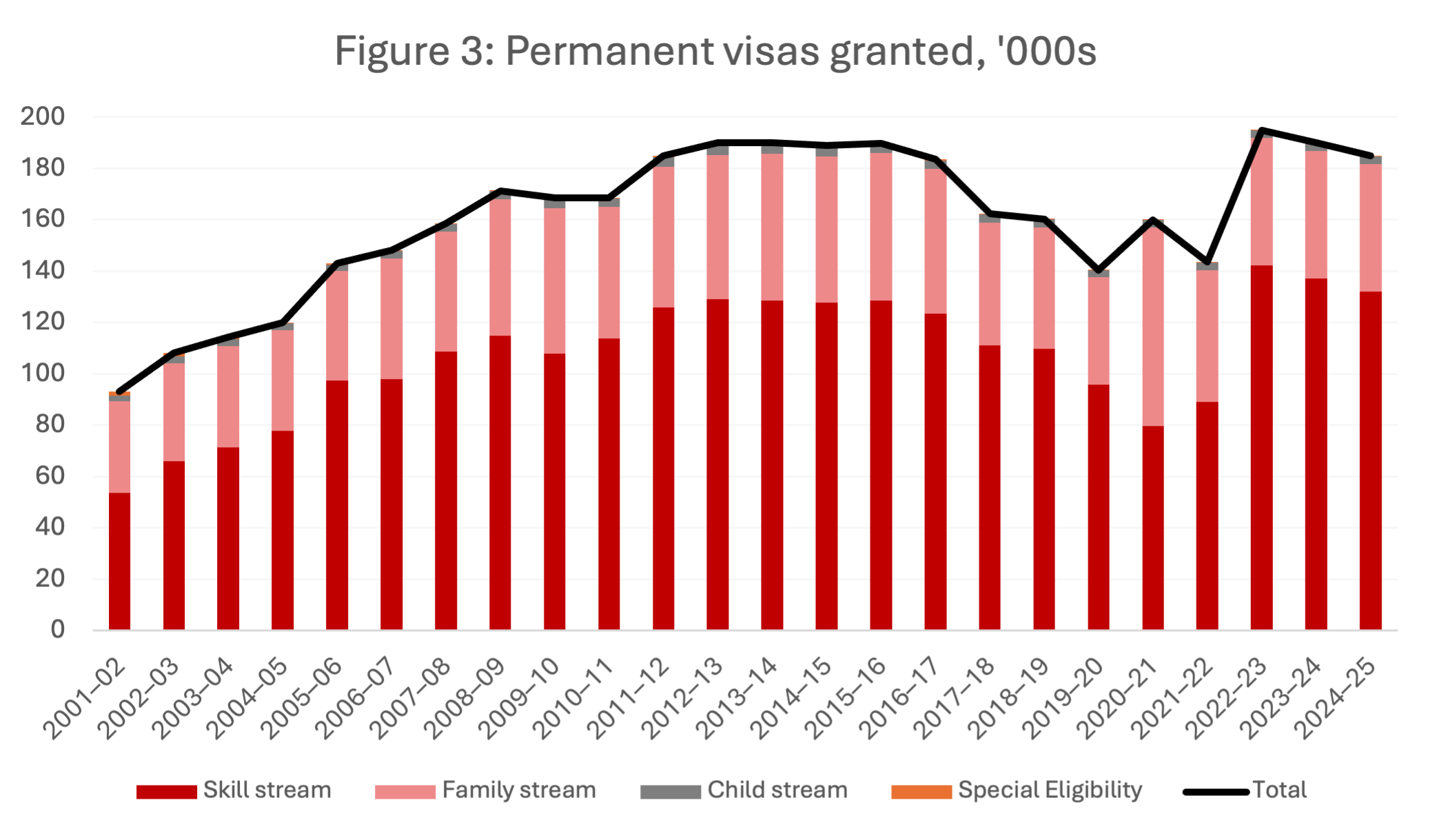 Source: Australian Bureau of Statistics
Permanent visa numbers have returned to pre-pandemic levels, with the majority flowing through the skilled stream (figure 3). In contrast, total temporary visas granted remain elevated, driven by elevated numbers of working holiday makers and temporary skilled workers (figure 4).
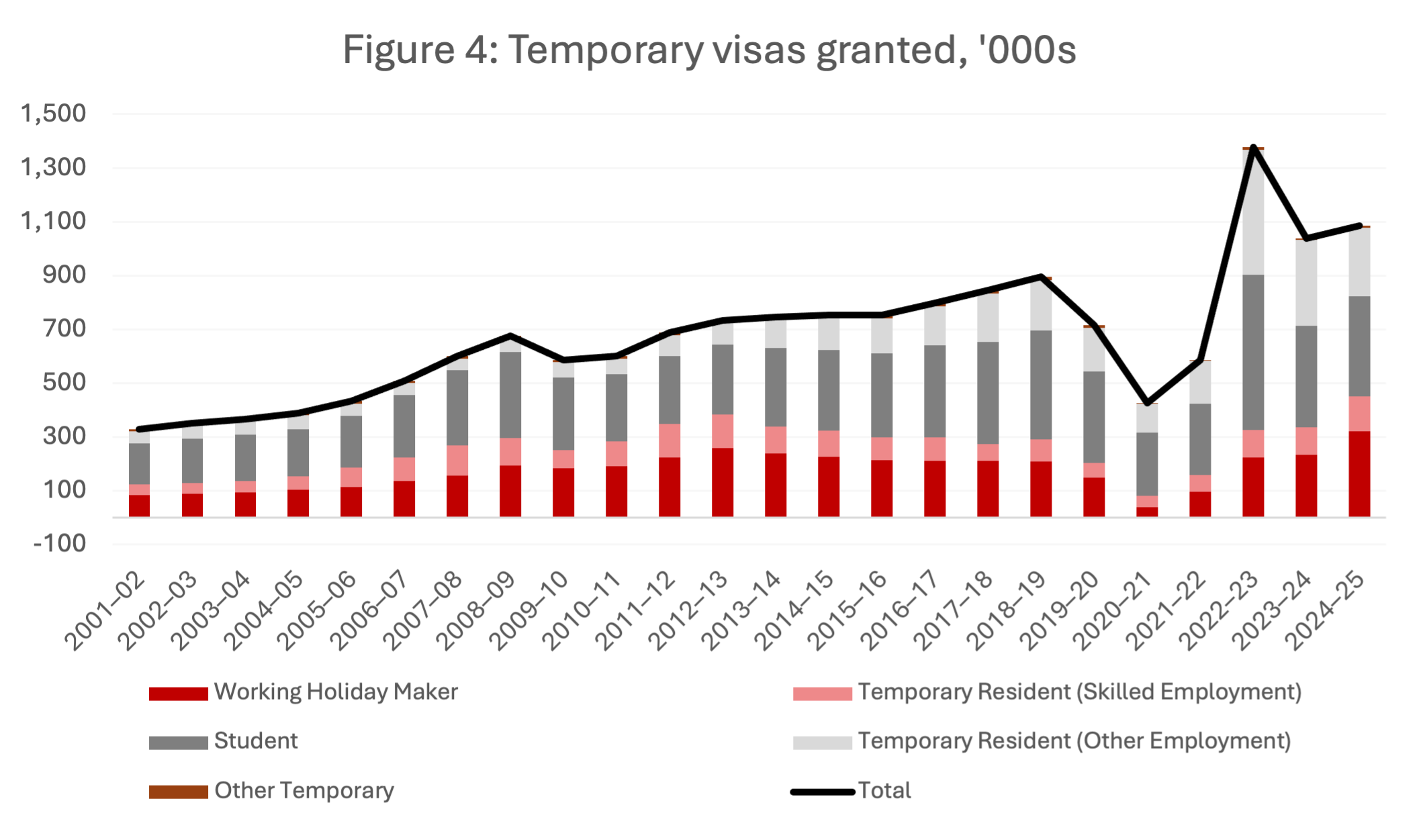 Note: Excludes Tourist, Crew and Transit, and Special Category (NZ citizen) visas
Source: Australian Bureau of Statistics
Migrants support Australia’s labour market and dynamism
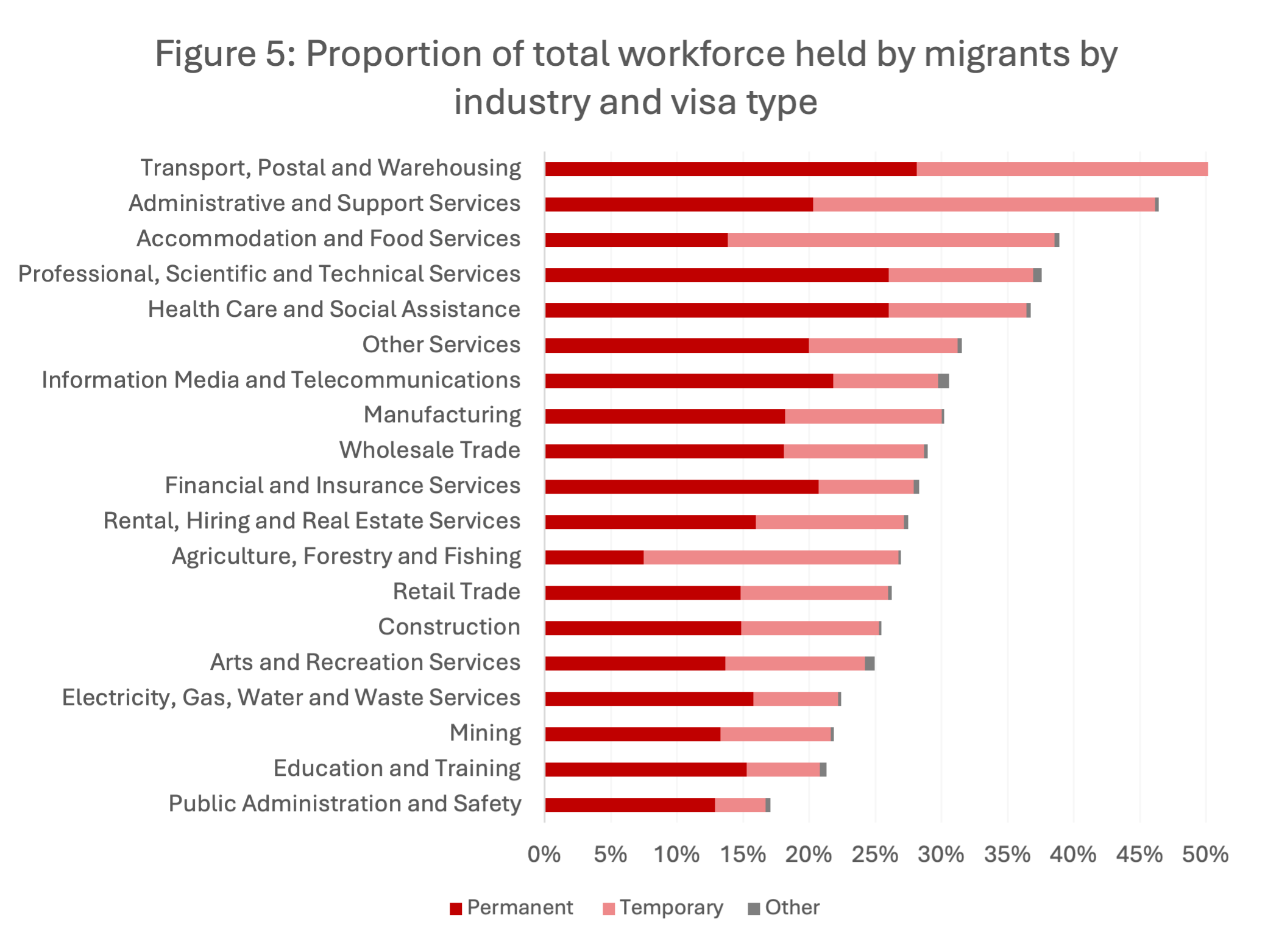
Migrants are well-represented across multiple sectors and account for around a third of all workers in healthcare, logistics, professional services and manufacturing (Figure 5). These workers play an important role in meeting labour and skills shortages that the domestic labour market alone cannot address.
For example, CEDA estimates that the aged care sector will require an additional 400,000 workers by 2050 as Australians get older, a shortfall that cannot be solely met through domestic workers.5 Immigration is already helping to meet this gap, with nearly one in five migrants who come to Australia choosing to work in healthcare and social assistance.
 Source: Australian Bureau of Statistics
Migrants also generally arrive in their prime working age, helping to offset some of the labour market challenges that would otherwise accompany an ageing population.6
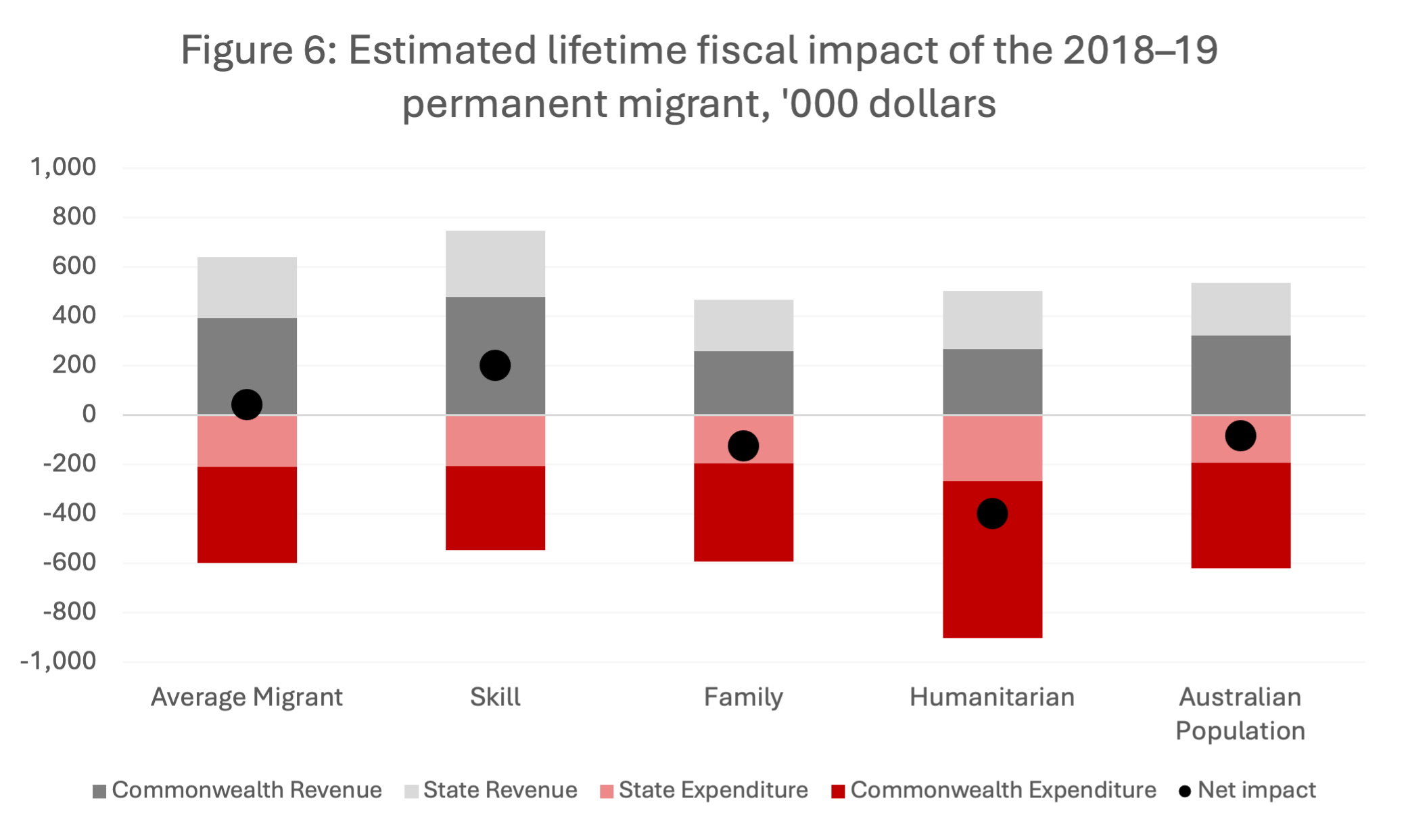
Additionally, migrants have historically made net positive fiscal contributions to Australia – that is, they pay more in taxes than they consume in government services (figure 6).7
 Source: Varela et al (2021)
Challenges in the migration system
Despite its many benefits, Australia’s migration system is not without its challenges.
While migrants do make valuable contributions to labour supply, employers and overseas workers can encounter frustrations when overseas skills and qualifications are not recognised. CEDA estimates that the imbalance between the skills possessed by migrants and the occupations they end up working in is worth $4 billion in foregone wages annually. This is a bad outcome for migrants and Australians.
Australia’s lack of affordable housing also brings focus on the pressure that Australia’s migrant intake exerts on rents and house prices. While this effect is modest and should be viewed in balance with the benefits migrants bring to the supply side of the economy, it does exist. Moallemi and Melser (2020) estimate that a 1% increase in immigrants to a postcode would increase house prices there by 0.9% per year.8
Moving toward better migration
Migration has been central to Australia's economic success and remains essential as our population ages and skill shortages persist. But success relies on building enduring community support for migrants and the contributions they can make.
To do so, policymakers need to ensure that our system is delivering for migrants and Australian residents alike. CEDA has recommended that this be achieved through streamlined essential skills visas in priority sectors, accompanied by better recognition of skills and broadening of support services.
[1] Australian Bureau of Statistics [ABS]. 2025. “Overseas Migration, 2024-25 Financial Year.” December 19, 2025. https://www.abs.gov.au/statistics/people/population/overseas-migration/latest-release.
[2] Commonwealth Treasury. 2026. “Federal Budget 2026-27: Budget Paper No. 1.” Table 2.2. https://budget.gov.au/content/bp1/download/bp1_bs-2.pdf.
[3] Gamlen, Alan, and Peter McDonald. 2026. “The Migration Splash: Why Australia’s Net Overseas Migration Surged and Fell After COVID-19.” ANU Migration Hub Insights. https://migration.anu.edu.au/sites/default/files/2026-02/The%20Migration%20Splash%20ANU%20Insights%20Briefing%2030.1.26.pdf.
[4] Department of Home Affairs. 2025. “Australia’s Migration Trends, 2024–25.” Australia’s Migration Trends. https://www.homeaffairs.gov.au/research-and-stats/files/migration-trends-2024-25.pdf.
[5] CEDA. 2025. “Duty of Care: How to Fix the Aged Care Worker Shortage.” https://www.ceda.com.au/research-and-policy/research/health-ageing/duty-of-care-how-to-fix-the-aged-care-worker-shortage.
[6] Commonwealth of Australia. 2023. “Intergenerational Report 2023: Australia’s Future to 2063.” https://treasury.gov.au/sites/default/files/2023-08/p2023-435150.pdf, pp. 49-50
[7] Varela, Peter, Nicholas Husek, Thom Williams, Richard Maher, and Darren Kennedy. 2021. “The Lifetime Fiscal Impact of the Australian Permanent Migration Program.” Treasury Paper. https://treasury.gov.au/sites/default/files/2021-12/p2021-220773_1.pdf.
[8] Moallemi, Morteza, and Melser, Daniel. 2020. “The Impact of Immigration on Housing Prices in Australia.” Papers of the Regional Science Association 99 (3): 773–86. https://doi.org/10.1111/pirs.12497.