
AI is changing the world order. Now is our time to shape it.
Register for the AI Leadership Summit in Sydney | 27 October
1 May 2026
In his address to the National Press Club in April, Prime Minister Albanese promised that May’s budget would be his government’s most ambitious yet.
The Government has every reason to be bold. A resounding win in last year’s election and the current global fuel supply crisis give it both the political capital and the narrative grounding to introduce genuinely impactful policy changes that can help address some of our most pressing economic challenges.
So, what will a ‘good’ budget look like? We’ve outlined four themes we’ll look for on budget night to assess the Government’s performance:
- A renewed and credible commitment to fiscal discipline
- Genuine commitment to reversing productivity stagnation
- A measured and effective approach to economic security and resilience
- Policy coherence
Current pressures, both geopolitical and fiscal, mean that these themes can’t be addressed in isolation. Getting the balance right will set Australia up to remain resilient to global headwinds, build our productive capacity and deliver on our social compact as a down payment on future prosperity.
A renewed and credible commitment to fiscal discipline
As Australians face down the fourth major global shock in six years,1 a new term has emerged – permacrisis. In this world, already-stretched budgets come under yet more strain as people increasingly look to governments to help weather the latest storm.
Australia has entered the latest crisis in a better position than most. Last year brought solid growth, unemployment has remained low, and geopolitical turmoil has provided tailwinds for exports of resources and energy. Some estimates suggest that heightened commodity prices could boost the budget bottom line by between $10-12 billion.
But longer-term fiscal trends are far less favourable and demand attention in the upcoming budget.
 Source: Parliamentary Budget Office
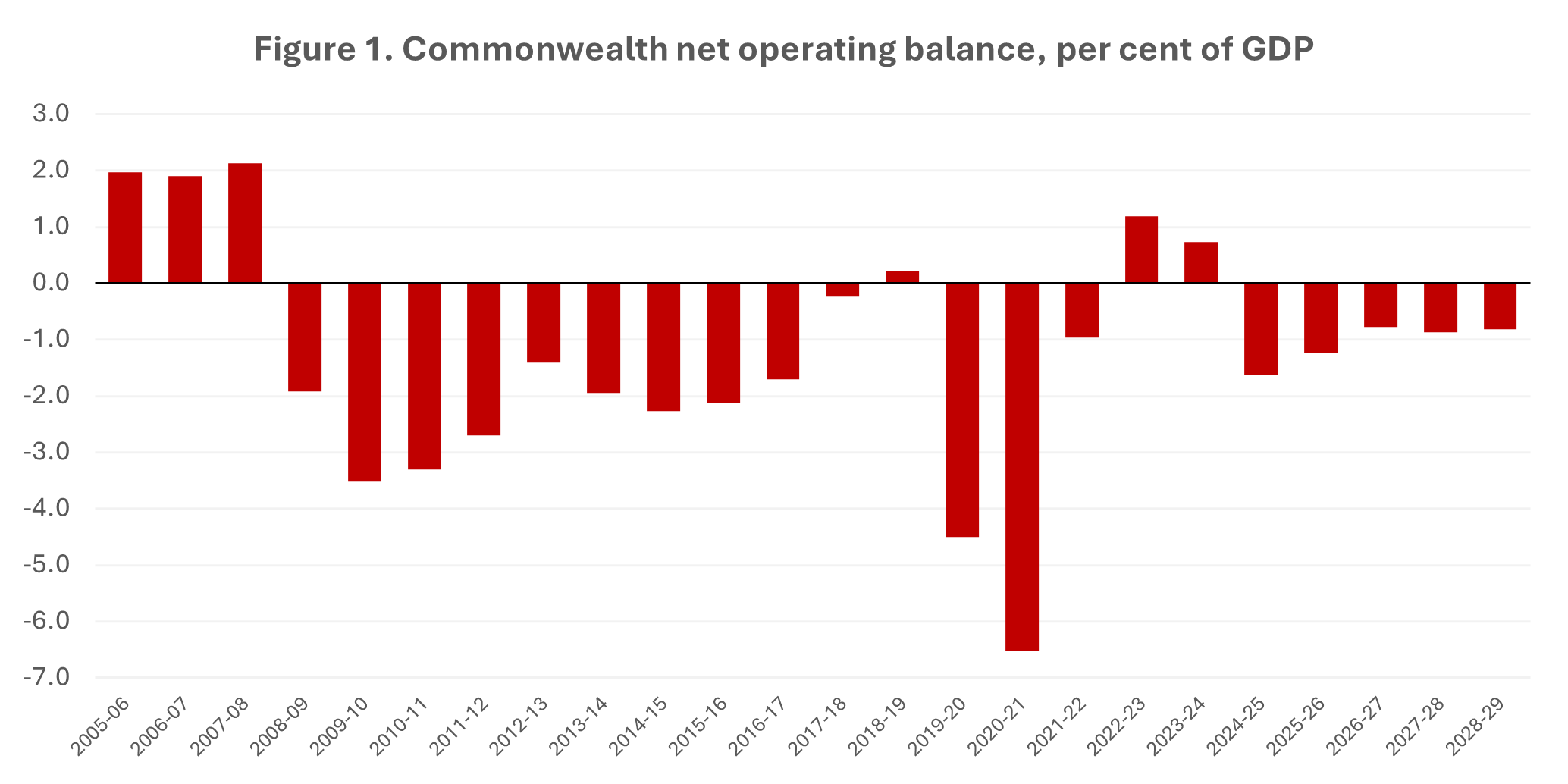
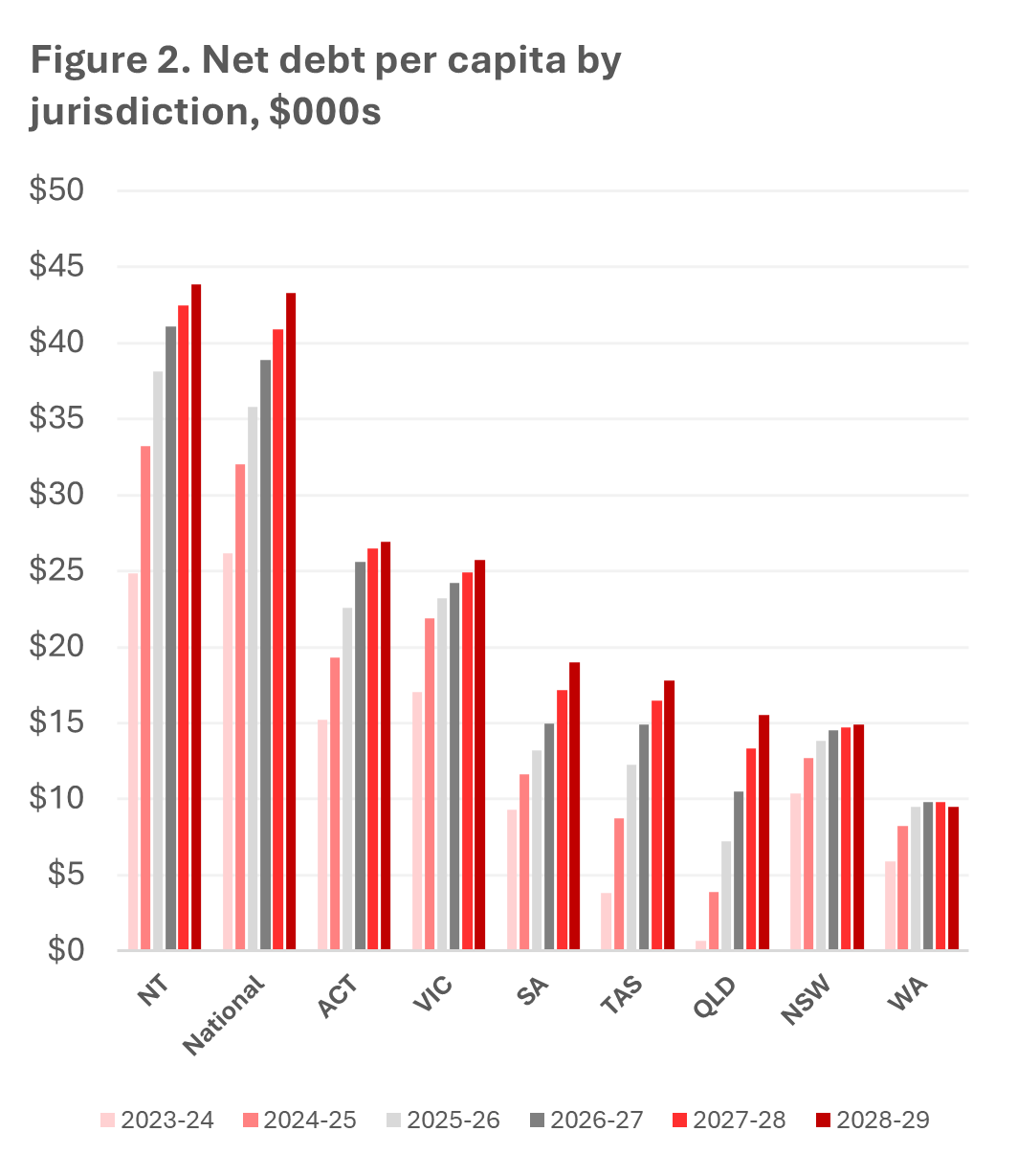
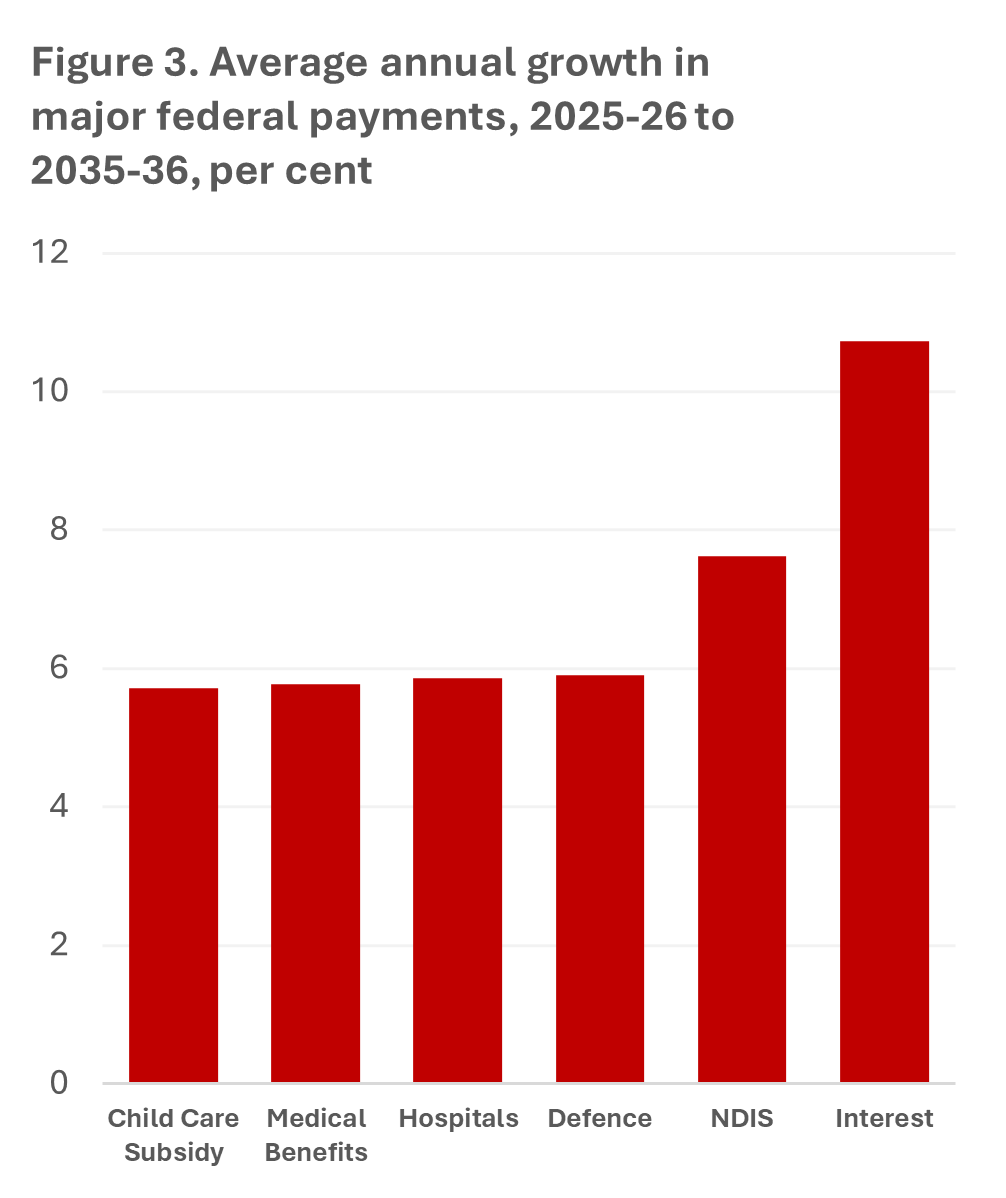
The net operating balance – the difference between government revenue and expenses – has been positive in just five of the past 20 years (figure 1). To make up the shortfall, governments have been accumulating debt, which currently stands at $36,000 per person (figure 2). While recent attention has focused on curtailing growth in NDIS spending, interest payments on debt are currently set to eclipse all other payment categories over the coming decade (figure 3).
 Source: Parliamentary Budget Office; MYEFO 2025-26.
 Source: Parliamentary Budget Office; MYEFO 2025-26.
While spending exceeds revenues, debt will only continue to accumulate and interest payments will absorb an ever-greater share of government finances. Where spending is directed matters too – recent years have seen much of it directed towards consumption rather than investing in building the productive capacity that can help to grow the economy over time and help pay down our debt.2
Together, this leaves less fiscal headroom to respond to shocks and to provide the things Australians care about – a good education, access to high-quality healthcare, and meaningful employment.
Come budget night then, CEDA will be looking for the Government to make good on its promise to introduce savings and tax packages that collectively shore up the bottom line.
Part of the heavy lifting has already come from $22 billion in cuts to the NDIS. Acting against these savings, though, is increasing spending on defence to 3 per cent of GDP and indications of heightened cost of living support. Also adding strain will be the effect of higher headline inflation results on CPI-linked income support payments. CEDA will be watching closely on budget night to assess the net effects of these developments.
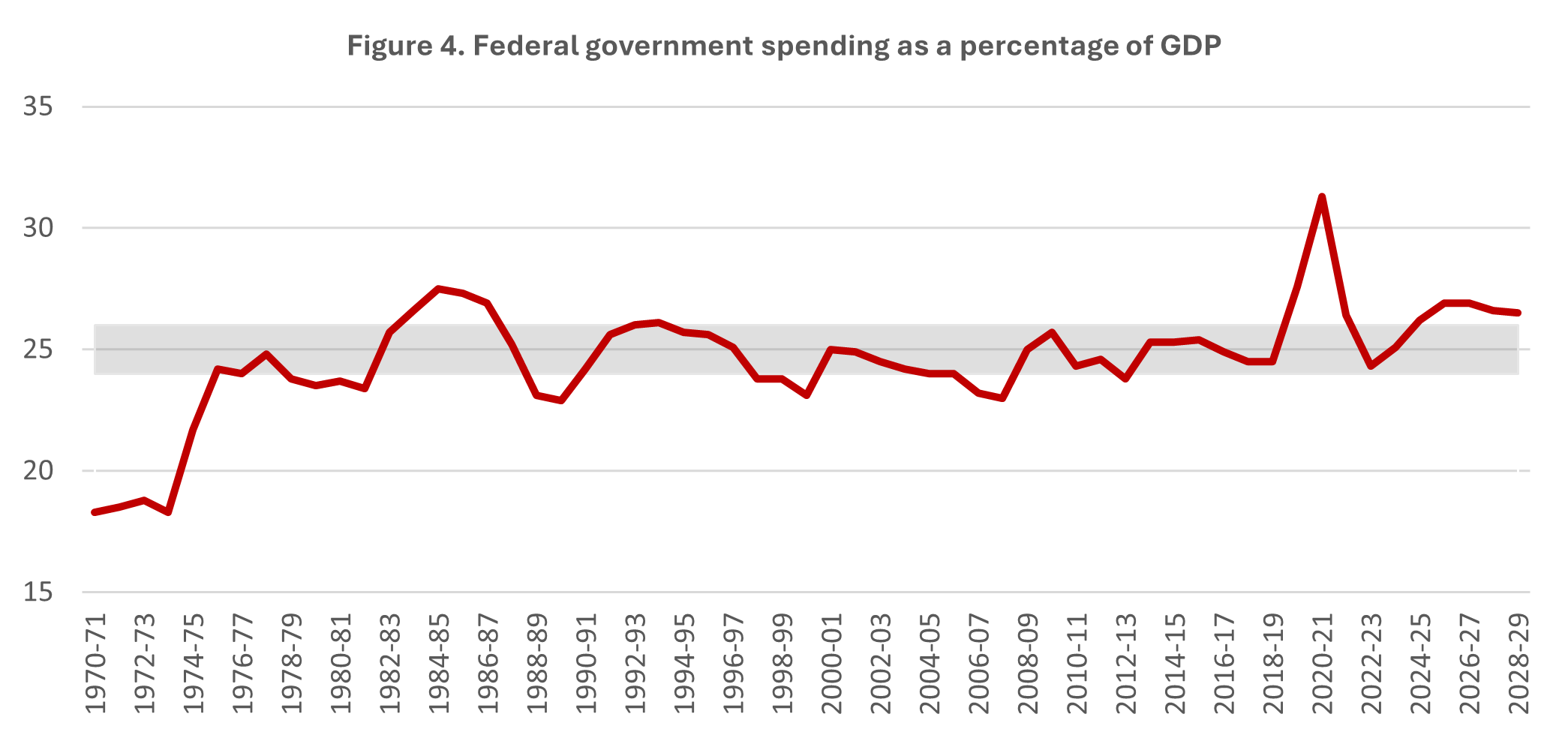
Over the longer term, the federal government should be guided by a target range for spending of between 24-26 per cent of GDP (figure 4). Introducing a range promotes discipline while also allowing greater flexibility to seize opportunities and respond to challenges than singular point targets.3 Spending at the midpoint of this range would achieve savings of roughly $213 billion over the forward estimates.
As with the Reserve Bank’s inflation target of between 2-3 per cent, a range aims to anchor choices over time rather than acting as a rigid limit. Like inflation, spending can sit above or below the range for a time. Remaining so for too long though will bring further costs down the road.
Accordingly, the Government should always be clear about what is being achieved by spending that sits outside of the band and the trade-offs these choices carry.
 Source: MYEFO 2025-26
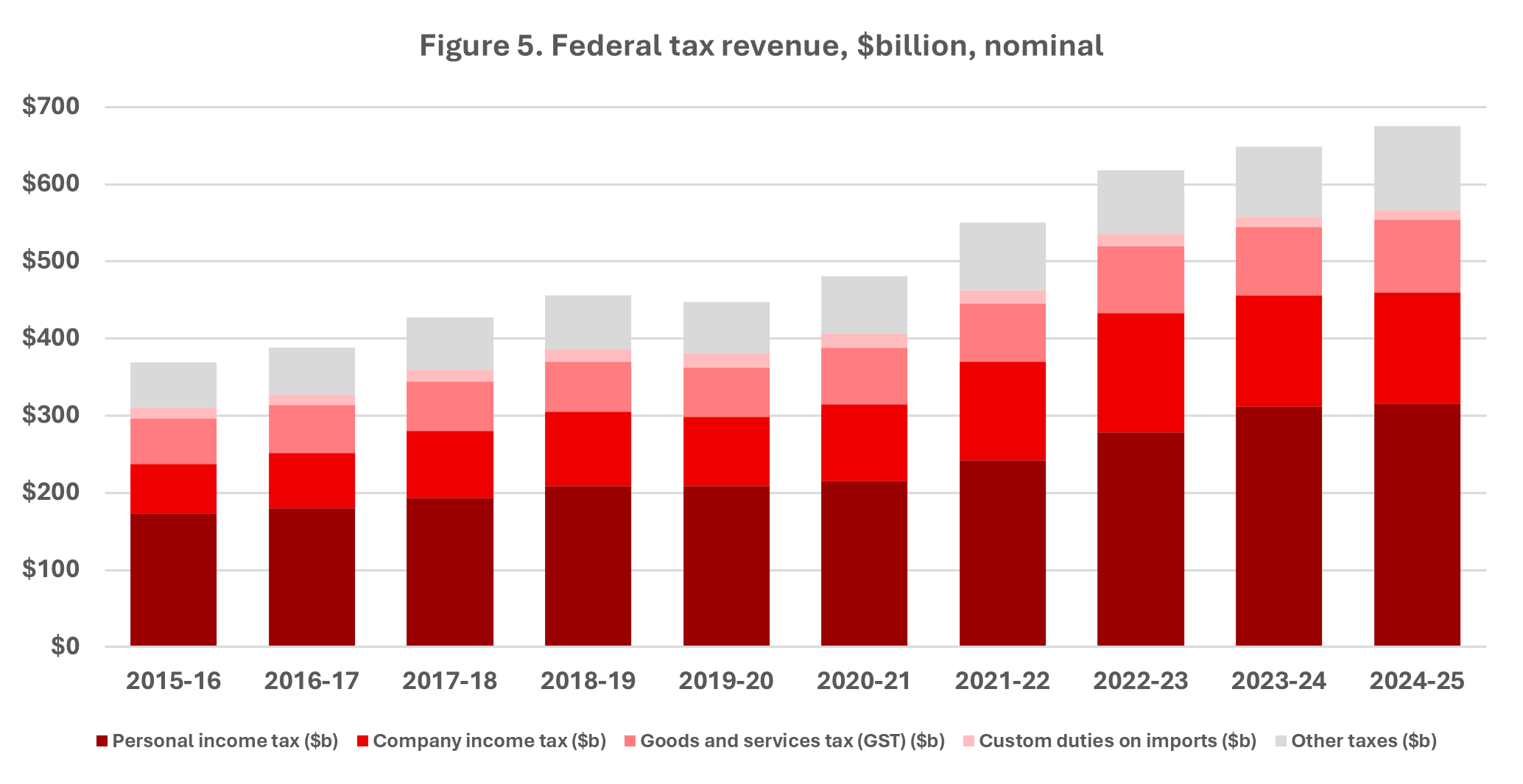
On the revenue side, newly released data shows that federal government tax receipts have been growing at a healthy clip (figure 5). But the composition of tax receipts needs to be addressed. Of the 40 per cent increase in tax receipts since the onset of the pandemic to 2024-25, 87 per cent has come from increases in income taxes.4 Increases in GST revenue contributed just 11 per cent.
 Source: Australian Bureau of Statistics
While allowing bracket creep to finance increased spending has been politically expedient, this growing penalty on work isn’t sustainable over the long run and sits uncomfortably with the goal of increasing participation and boosting productivity. Unchanged, these settings will erode the incentive to invest in education and work at a time when we need it the most.5
A good tax package on budget night will see the Government shifting to a more efficient and equitable tax mix. Changes should be judged on whether they safeguard the progressiveness of the system, address market failures, encourage investment, prioritise simplicity and support intergenerational equity.
These aren’t easy changes to make, and success will involve careful and pragmatic policy design. But there are several steps the Government should immediately prioritise to strengthen fiscal discipline.
- Broader means testing: CEDA continues to advocate for scaling the level of government support based on individuals’ – and businesses’ – ability to pay their own way. Recent years have seen a rise in untargeted financial support across all levels of government, from universal electricity rebates and cuts to fuel excise through to student debt relief. Doing so heightens the risk of inflation, adds extra strain on the budget and undermines confidence in a system which people increasingly perceive to be unfair.
- Better evaluation of policy: Increasing economic headwinds mean that we need to have better visibility of which policies are working and which aren’t. This means broader evaluation of whether spending is delivering on policy objectives that have been clearly articulated to the community. While we’ve seen some progress here there is still work to do, with only 32 per cent of agencies routinely releasing evaluation findings publicly.
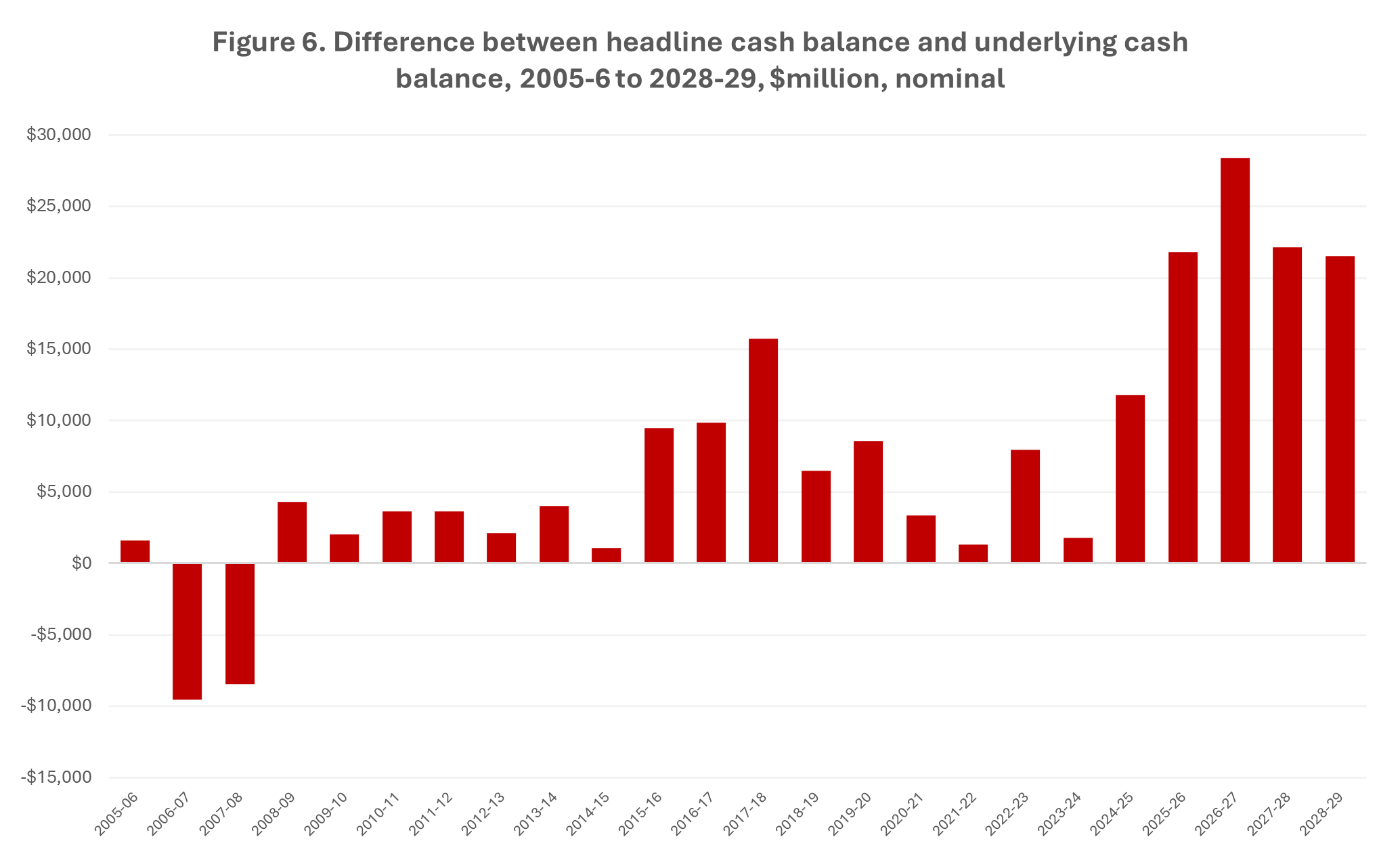
- Focus on transparency: The rise of off-balance sheet spending has also diminished transparency and accountability and should be addressed. Special investment vehicles have been increasingly favoured in recent years, with the change most visible in the divergence between the headline cash balance, which includes these programs, and the underlying cash balance, which omits them (figure 6).
 Source: MYEFO 2025-26
Genuine commitment to reversing productivity trends
Of all the levers the Government can pull to get the country’s finances back on a sustainable path, boosting productivity is by far the most attractive.
Gains here can play a meaningful role in supporting both the budget and households. Returning productivity growth to its historic average would see Australians $14,000 better off per person by 2035.6 Doing so would also allow the economy to grow while limiting the risk of stoking resurgent inflation.
Productivity Commission chair Danielle Wood has highlighted that improvements to productivity aren’t likely to come in one ‘big bang’ – rather, meaningful progress is likely to follow the success of many small changes.
CEDA has advocated for a more seamless national economy, where regulation is streamlined and duplication reduced. We would also like to see the Government play a stronger role in supporting AI adoption, not just in the economy at large, but within government processes. And while migration is increasingly a vexed issue in the community, CEDA research highlights that better utilising the skills of migrant workers could unlock $4 billion in benefits annually.7
What shape reform takes on budget night remains to be seen. But with business investment and productivity growth at multi-decade lows, this is a problem that cannot be kicked down the road any longer.
A measured approach to economic security
The magnitude of recent shocks creates pressure for the Government to be seen as taking strong action. This has brought calls for everything from domestic oil exploration and expanded storage of fuels and fertiliser to increasing the level of manufacturing done in Australia.
A good approach in the Budget will see the Government carefully weighing the benefits and costs of its responses to the crisis – in the near term and over longer horizons.
Federal policies exert significant influence on decisions about when, where and how people and businesses invest, with consequences that reverberate for years to come. Decisions to expand stockpiles of critical imports, for example, may over time reduce the incentive for businesses to manage risks themselves and will come at the expense of spending in other areas, like health or education.
In an environment of heightened uncertainty and vulnerability, new measures to strengthen Australia’s economic security are likely warranted. But the scale of their potential impacts and influence means that the Government should be explicit about the national benefits as well as the costs, risks and trade-offs that any proposed responses entail.
Policy coherence
A successful budget will have policies that are pointing in the same direction, not working at cross-purposes. There simply isn’t the fiscal headroom to do otherwise.
One example is the government’s approach to decarbonisation. Here, the Government continues to subsidise the consumption of fossil fuels through its $10 billion per year fuel excise credit scheme. At the same time, billions are being spent on programs like Cheaper Home Batteries and pushing for new vehicles to reduce emissions. Put together, these policies make less sense.
Similarly, the Government knows that cost of living support that isn’t well-targeted and time-bound can run counter to the goal it shares with the Reserve Bank of reducing inflation. Untargeted fiscal support following the COVID pandemic was one driver of the spike in inflation experienced globally – we’ll be watching closely on budget night to see whether the government takes on the lessons of recent history.
Hard choices for long-term sustainability
As the Government makes its final preparations for the May Budget, the Prime Minister and Treasurer have emphasised that current headwinds make the need for reform more compelling, not less. We agree.
The extraordinary challenges presented by the unfolding crisis in the Middle East underscore the role that a strong, resilient economy can play in supporting Australians through times of hardship.
Unfortunately, the current crisis is unlikely to be the last. But with a renewed focus on fiscal sustainability, productivity, economic security and policy alignment, the upcoming budget can help position Australia well to withstand future shocks.
1. The COVID pandemic, Russia’s invasion of Ukraine, the United States’ “Liberation Day” tariffs, and now the conflict in the Middle East.
2. E61 Institute (2026). Rising Pressures, Fading Discipline: A Review of Australia's Fiscal Sustainability.
3. See CEDA’s previous work, Sustainable Budgets.
4. Includes taxes levied on individuals, enterprises and non-residents.
5. Parliamentary Budget Office (2024). Australia’s Tax Mix: The roles played by different taxes and how they have changed over time. https://www.pbo.gov.au/sites/default/files/2024-11/PBO%20Australia%27s%20Tax%20Mix-Budget-Explainer.pdf
6. Wood, D. (2025). Growth mindset: How to fix our productivity problem. https://www.pc.gov.au/media-speeches/speeches/growth-mindset/
7. See CEDA’s submission to the Select Committee on Productivity here. A full list of CEDA’s policy recommendations can be found here.