
Be part of the conversation shaping Australia’s future
Duty of care: How to fix the aged care worker shortage calls for more action to be taken to address Australia’s shortage of aged care workers. It recommends that the Federal Government introduce an essential skills visa for occupations facing severe and ongoing worker shortages in the care sector, starting with aged care. This report contributes to the wellbeing, security & participation focus area of CEDA’s Progress 2050 vision for a better future for the next generation of Australians.
REPORT SUMMARY
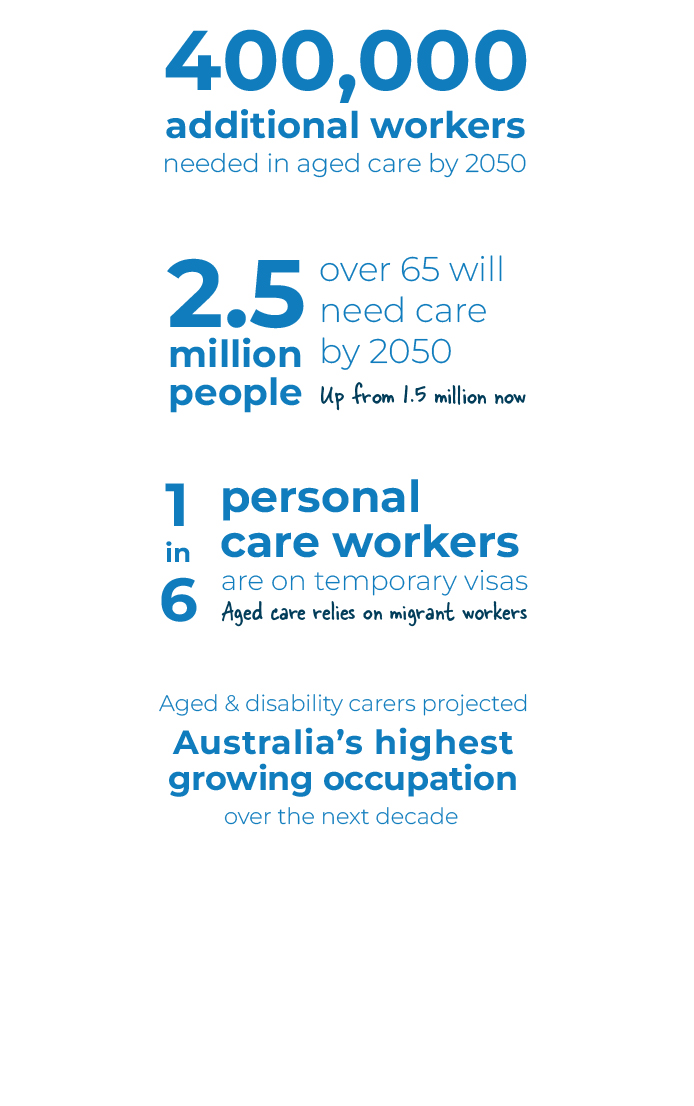
CEDA has previously shown Australia will require at least 400,000 additional workers across residential and in-home aged care by 2050 to meet growing demand. There has not been enough progress to close this gap. This is a long-term challenge that requires a bold response.
The solution to the shortage is multifaceted. Australia must build a sustainable domestic pipeline of aged care workers as a priority. But this alone will not be enough. We must also continue to explore how to optimise migration to sustainably grow the sector's workforce. Given the size of the shortages, it is not feasible to meet demand through domestic training and hiring alone.
The Federal Government acknowledged the strong role migration plays in the sector in its 2023 Migration Strategy, committing to looking at an essential skills visa pathway for lower wage migrant workers in sectors with critical workforce shortages, such as personal care workers in aged care. CEDA advocated for such a visa in its submission to the Migration Review. There has been no noticeable progress on this pathway.
The Government has sought to respond to the need via labour agreements, initially through company-specific agreements and then by introducing the Aged Care Industry Labour Agreement (ACILA), which covers three key occupations: nursing support worker, personal care assistant and aged or disabled carer.
These agreements aren’t bringing in anywhere near enough workers to fill the gap and do not meet the underlying need for a new visa pathway. We estimate that in the June quarter of this year, less than four per cent of temporary migrants in these occupations were in Australia on a labour agreement.
Most migrant workers continue to come into the sector as sideways entrants. The vast majority of migrant workers in the occupations covered by the agreement came to Australia on temporary visas for other purposes, such as student, partner or working holiday visas.
We’ve found providers are using labour agreements to retain a small number of existing staff already in the country, rather than increasing the overall number of workers in the sector by attracting additional staff from overseas.
The ACILA is not meeting the needs of the sector – it is not bringing in enough workers to meet demand. Consultation with industry also suggests there is unlikely to be a significant increase in uptake of the scheme.
This approach must change if we are to meet the aged care needs of the future.
This is not a short-term problem in need of a temporary fix. It is long-term in nature. We need to pull all levers, including migration, to increase the workforce.
The Government should pursue an essential skills visa for aged care workers as a priority.
CONCLUSIONS
Providers and the Government should continue efforts to build a sustainable pipeline of Australian aged care workers as a priority, ensuring that pay and conditions are appropriate to attract new workers while also retaining the existing workforce.
CEDA has previously made recommendations to improve domestic training, retention and technology to increase the workforce. But this alone is not enough.
Where shortages persist, our migration system should be able to respond rapidly.
Despite the good intentions behind its creation, the aged care industry labour agreement has not been effective at bringing new workers into Australia. It has helped providers retain existing migrant staff by offering them a new visa sponsorship pathway, and this is a positive outcome. But there are other ways to retain staff, including better career progression, training, pay and conditions and flexible working arrangements.
An essential skills visa should be introduced, along with an online system to match prospective workers overseas with Australian employers, to help ensure its success.
Rigorous evaluation should be undertaken to ensure the visa pathways are meeting their objectives and that migrants, Australian workers and providers are all benefiting. .[i]
RECOMMENDATIONS
- The Federal Government should introduce an essential skills visa for aged care occupations below the wage thresholds in recognition of the ongoing shortage and anticipated growth in demand for workers. The visa would provide a pathway for the same occupations as the aged care industry labour agreement.
- Labour market testing should be abolished for the three occupations covered by the agreement, as they face critical shortage. It can be replaced by regular evaluation of the visa’s effectiveness every three to five years.
- The Government should consider waiving or reducing the Skilling Australia Fund levy for employers sponsoring a worker on an essential skills visa. It should also only be payable once per migrant in cases where the worker moves from one sponsored visa to another, such as from temporary to permanent sponsorship visa.
- The Government should consider making employers’ sponsorship costs payable pro-rata, rather than upfront. This could be in the form of a loading paid to the Government in addition to employees’ regular pay for the duration of the sponsorship.
- The Federal Government, either through the Australian Institute of Health and Welfare, the Australian Bureau of Statistics or the Department of Health and Ageing, should provide nationally consistent annual data on the aged care workforce, to better support workforce planning.
Author

Tim Kane
Senior Economist
Tim Kane
Senior Economist