


AI is changing the world order. Now is our time to shape it.

Register for the AI Leadership Summit in Sydney | 27 October

Executive summary
Fit for purpose: Aligning Affordable housing with need

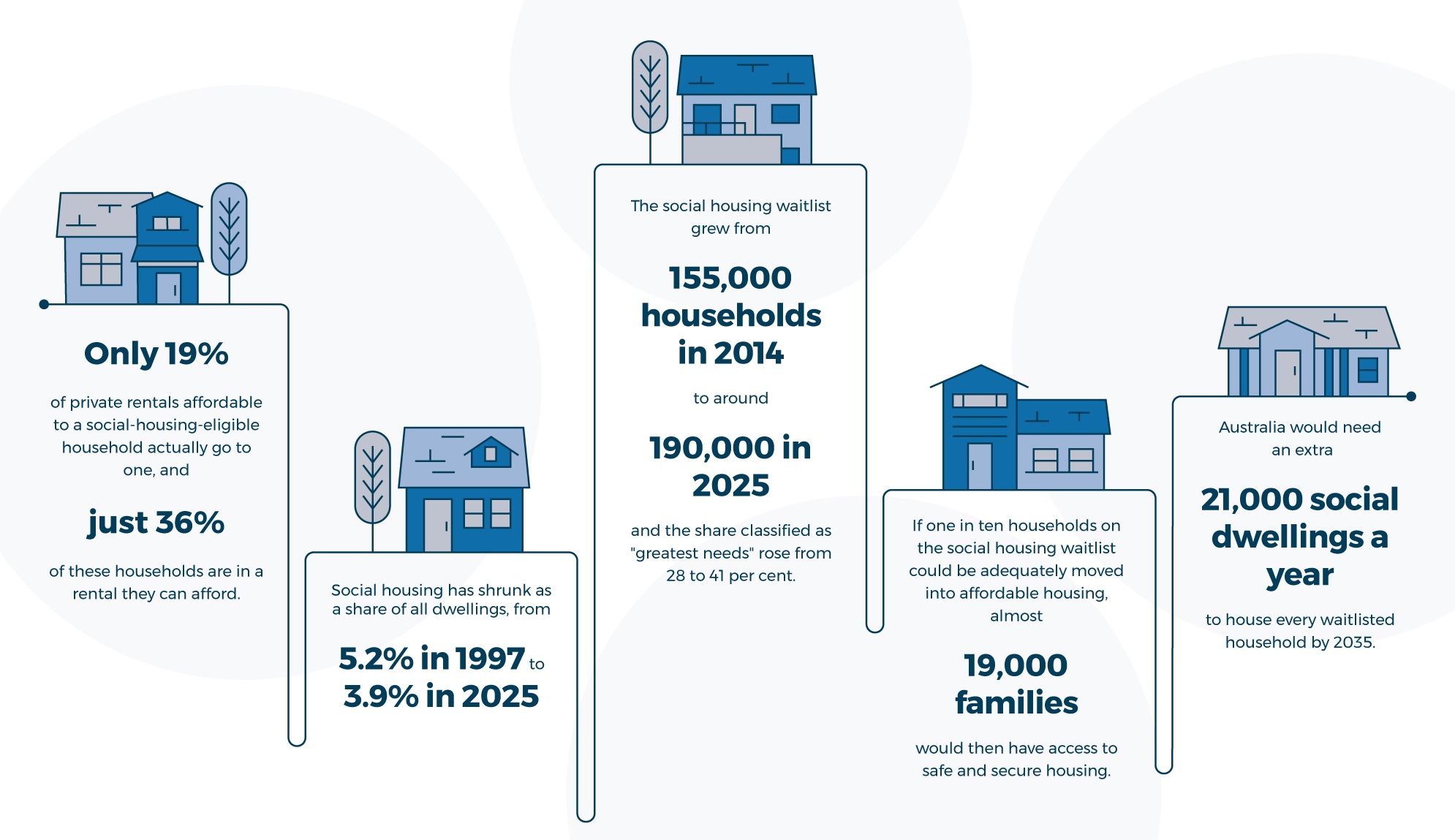
Australia’s social and Affordable housing system is failing the households who need it most. Social housing has shrunk from 5.2 per cent of total dwellings in 1997 to 3.9 per cent in 2025, while waitlists have climbed from 155,000 households in 2014 to 190,000 in 2025. The share of applicants classified as “greatest needs” has risen from 28 per cent to 41 per cent over the same period. 

Households shut out of social housing are pushed into a private rental market that increasingly cannot accommodate them and that they cannot afford. Advertised rents have risen 48 per cent over the last ten years, well ahead of wages. One in five renter households is a low-income household in financial stress, and two in five Commonwealth Rent Assistance recipients remain in rental stress even after receiving the payment. Rental stress is commonly defined as housing costs above 30 per cent of gross income for households in the lowest 40 per cent of the income distribution. 

At the same time, the lower-cost housing that does exist is not reaching the households that most need it. Nationally, fewer than one in five rentals (19 per cent) that would be affordable for a low-income, social-housing-eligible household goes to one. Meanwhile, just 36 per cent of these households are in a private rental they can afford.

Government and industry have recognised the need to take action to provide housing relief. The Federal Government created the Housing Australia Future Fund (HAFF) to build 40,000 additional social and Affordable homes, backed by an initial $10 billion investment. Despite these supports, the challenge continues to grow. 

Australia’s housing shortages have grown over more than two decades, through inadequate housing supply and underinvestment in social housing. Building the supply of social housing back up to a level that meets the level of need requires sustained investment and long-term commitment, both in its construction and maintenance.

The annual recurrent expenditure cost to Government of public housing is $55,981 per dwelling, well above what public housing tenants can reasonably pay. As the social housing stock expands, funding must grow to support the new homes alongside the operation, maintenance and renewal of existing homes. 

Affordable housing could relieve some of the pressure on social housing waitlists. At present though, it does not support those households most in need. Affordable rents are set at a discount to market rates, not as a share of what a household earns. In an expensive market, a discount applied to a high rent is still a high rent, and the lowest-income households the scheme is meant to serve cannot pay it. Eligibility runs from very-low to moderate incomes, so people who earn more absorb the stock while very-low and low-income households are crowded out. Those in greatest need get little relief, and the social housing waitlist barely moves. If one in ten households on the social housing waitlist could be adequately moved into affordable housing, almost 19,000 families would then have access to safe and secure housing.


Like social housing, Affordable housing also faces a structural funding gap. The rent that very-low and low-income households can afford does not cover the cost of land, construction, finance and maintenance. That gap has widened as construction and finance costs have risen faster than the incomes of households this housing is meant to serve. Incentive-based schemes that allow density uplift for the provision of Affordable housing, allow that gap to be covered through the construction of additional market-rate dwellings in the development. 

However, the value generated by uplift is often not deep enough to reach the households with the greatest need, so these schemes tend to deliver dwellings affordable to moderate-income earners while the gap for very-low and low-income households remains. Ongoing and consistent funding is needed to fill this gap. Even where the scheme covers delivery costs, managing the dwellings or engaging a community housing provider adds complexity, compliance cost and long-term risk to an otherwise straightforward project. 

Australia needs more housing and it especially needs more affordable housing that can be accessed by those who need it most.


In partnership with

In partnership with Urbis


Report authors

Jonathon Mahon

CEDA Economist

Author

Danika Adams

CEDA Chief Research and Content Officer

Author

Mark Dawson

Urbis Partner

Contributing author

Jonathon Mahon

CEDA Economist

Author

Danika Adams

CEDA Chief Research and Content Officer

Author

Mark Dawson

Urbis Partner

Contributing author


Support our research


CEDA exists to provide independent thinking and research to influence public policy, building long-term prosperity for all Australians. 

A tax-deductible donation to CEDA directly supports our research, government and industry engagement, and convenings.


Donate now >>