


Executive summary
Permission to build: Turning planning reform into housing delivery

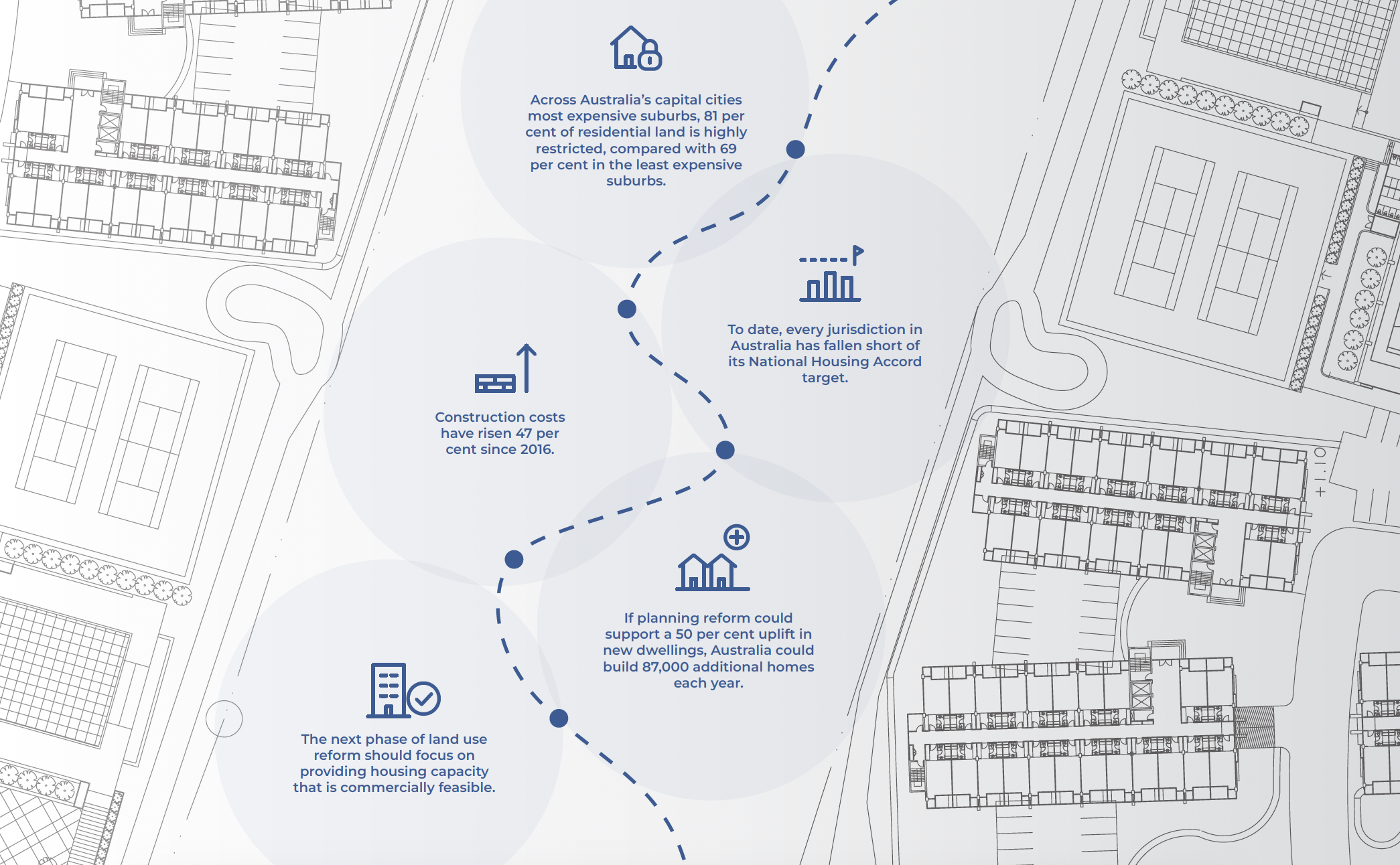
The National Housing Accord began in 2024 and sets targets for new housing over the five years to 2029. To date, every state and territory in the country is behind its target. A large driver of the shortfall has been construction costs, which have risen 47 per cent since 2016. As a result, much of the theoretical housing capacity in the system is not commercially feasible to build and remains unrealised. The correct measure of zoning and regulation reforms should be the amount of capacity that is commercially feasible for new housing to be built.

Commercial feasibility is strongest where sale prices are the highest, as higher prices enable developers to more easily recoup the costs of construction, which are relatively constant across cities. 

Yet across Australia’s cities, the most expensive suburbs impose the greatest barriers to building new housing, limiting the number of new dwellings that can actually be built there.

In Australia’s most expensive suburbs, 81 per cent of residential land is highly restricted, compared with just 69 per cent for the least expensive areas. Zoning uplift is being directed towards the less expensive areas of cities, where it is least commercially feasible to build new housing.

If planning and regulatory reform could support even a 50 per cent increase in dwelling completions, Australia could build around 87,000 additional homes each year, enough to meet the annual targets of the National Housing Accord.

States have begun moving in the right direction. Fast-track assessment pathways, state-led precinct planning, transport-oriented development and more consistent planning controls are improving certainty and unlocking well-located sites. But these well-intentioned reforms must also address and consider the underlying economics of development. Rezoning will not produce homes if it is not targeted at development that is commercially feasible.


Going forward, the next phase of land use reforms should focus on feasible capacity. Governments should target planning uplift in high-demand, well-serviced locations and remove controls that add cost without adding value. At the same time, density should be enabled more broadly across established suburbs through reduced minimum lot sizes. NSW’s shift towards measuring feasible and realisable housing capacity is one example where this shift is starting to take place.

Planning and infrastructure should be treated as one system, with capacity directed to places where transport and community infrastructure already exist or can be upgraded efficiently. Where new infrastructure is required, it should be funded and sequenced alongside rezoning, with contribution charges known early, applied consistently and transparently, and structured so they do not push otherwise viable projects below the feasibility threshold.


In partnership with

In partnership with Urbis


Report authors

Jonathon Mahon

CEDA Economist

Author

Danika Adams

CEDA Chief Research and Content Officer

Author

Stephen White

Urbis Partner

Contributing author

Jonathon Mahon

CEDA Economist

Author

Danika Adams

CEDA Chief Research and Content Officer

Author

Stephen White

Urbis Partner

Contributing author


Support our research


CEDA exists to provide independent thinking and research to influence public policy, building long-term prosperity for all Australians. 

A tax-deductible donation to CEDA directly supports our research, government and industry engagement, and convenings.


Donate now >>